Incident Overview
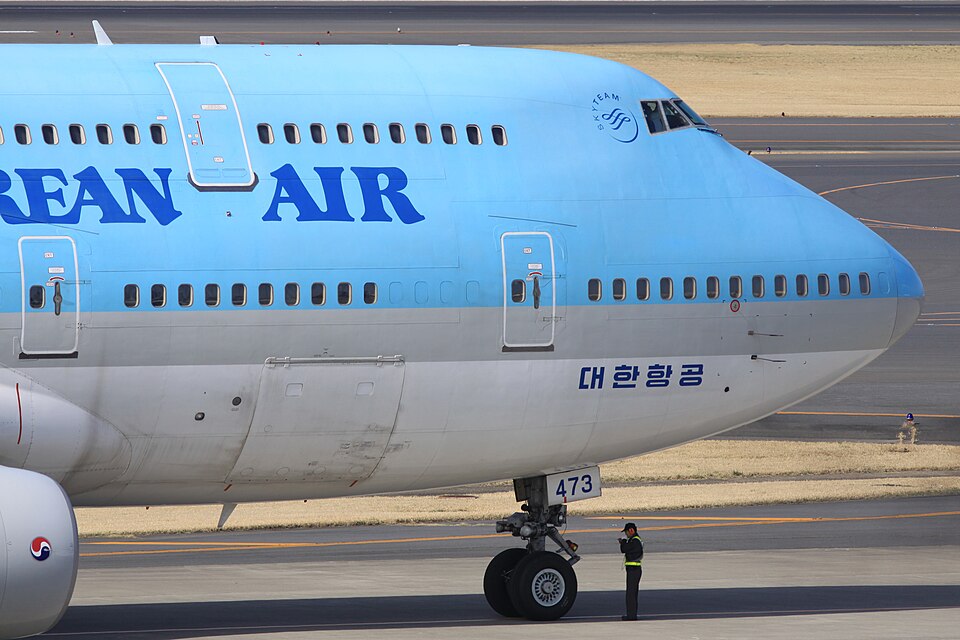
On July 5, 2012, a Boeing 747-400 operated by Korean Air Lines Co., Ltd., registration HL7473, was conducting scheduled flight KAL2711 from Gimpo International Airport, Republic of Korea, to Tokyo International Airport, Japan. The aircraft carried 194 persons: 2 pilots, 15 flight attendants, and 177 passengers.
Flight History
The aircraft departed at 19:11 JST. During the initial climb, light shaking occurred and the fasten seat-belt sign was illuminated. After reaching cruising altitude, the shaking stopped and the sign was turned off. Later, light shaking resumed and the sign was turned on again. Around 20:05, small vertical accelerations began, recorded by the flight data recorder. The aircraft descended in visual meteorological conditions (VMC) with continued light shaking. The onboard weather radar showed no echoes, so the fasten seat-belt sign was turned off. Several minutes later, the aircraft experienced a sudden violent shaking for 2-3 seconds. A passenger standing in the aisle was thrown off-balance, struck his back against the L4 door, and fell to the floor.
Injuries and Damage
The passenger, a 55-year-old male, was diagnosed with a bone fracture. No other injuries or damage to the aircraft occurred.
Meteorological Conditions
A seasonal rain front extended from the Yellow Sea to the Kinki region. Moderate turbulence was forecast at altitudes 13,000-23,000 ft near clouds. The atmosphere was unstable due to a trough with cold air, leading to convective cloud development. An hourly analysis showed sporadic vertical wind shear (VWS) of 6-9 kt/1000 ft at 23,000-26,000 ft. Weather radar imagery indicated an echo with top heights of 20,000-30,000 ft and central strength of 80 mm/h near the accident airspace at 20:20. The flight data recorder recorded a quick wind change of 20° direction and 10 kt velocity at 20:30.
Probable Causes
The Japan Transport Safety Board concluded it is highly probable that the accident occurred because the aircraft encountered turbulence during descent, causing a passenger not seated to be thrown off-balance and sustain serious injuries. The turbulence likely resulted from vertical wind shear or unstable atmospheric conditions where convective clouds developed.