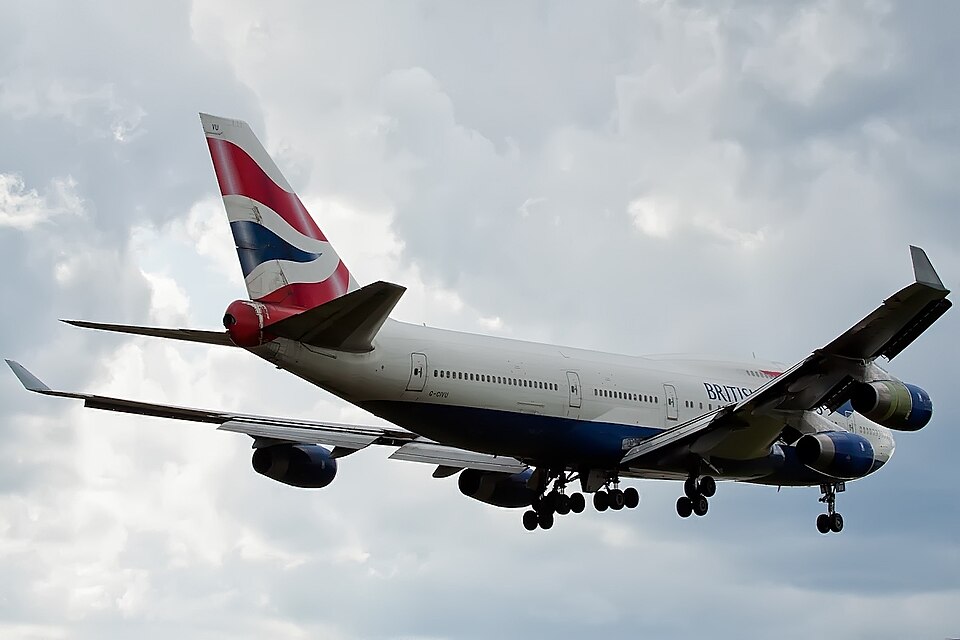
Incident
On 20 December 2019 at 1543 UTC, Boeing 747-436 G-CIVU collided with a fuel transfer vehicle (FTV) while taxiing onto Stand 331 at London Heathrow Airport. The aircraft had landed on Runway 27R at 1537 hrs and was proceeding to its parking position. The collision occurred in darkness and heavy rain. Neither the flight crew nor the ground staff supervising the arrival saw the FTV before the impact. The FTV driver, who was in the cab, was not injured. Damage was limited to the No 1 engine cowl and the rear of the FTV; both were repaired and returned to service.
Sequence of Events
The stand had been occupied by an Airbus A320 operated by the same company, which was pushed back at 1539 hrs to allow the 747 to enter. The commander of the 747 reported focusing initially on the right wingtip clearance from the Airbus and did not see the FTV. He noted difficulty seeing stand markings due to standing water, heavy rain, and glare from terminal lights. The stand guidance system had been illuminated, indicating the correct aircraft type, and the aircraft parked normally before shutdown. After passenger disembarkation, the crew were informed of the collision.
Ground Handling
Two ground supervisors were assigned to the arrival. One supervisor walked the stand centreline to check for foreign object debris but did not see the FTV; he then proceeded to the jetty. The other supervisor, at the guidance control panel, saw his colleague walking the centreline and assumed the stand was clear, so he activated the guidance system. He then stood by the emergency stop button, but from that position he could not see the right side of the stand where the FTV was parked. He was unaware of the collision and did not stop the aircraft.
The FTV driver had refueled the Airbus and moved the vehicle forward a few meters but remained on stand to complete paperwork. He was using a tablet that had frozen and was wearing ear defenders, so he did not hear the approaching 747. The collision pushed the FTV forward; the driver then moved away and reported the incident.
Investigation and Safety Actions
The operator's investigation found that ground handling procedures had been revised but were not consistently implemented. A January 2019 instruction allowed a visual check from the head of the stand instead of a centerline walk for every arrival, but this had not been incorporated into standard operating procedures. Procedures did not address scenarios with two supervisors or clarify responsibilities for ensuring the stand was clear. The operator is conducting an independent review of procedures to ensure clarity, accountability, and a single information source. Additionally, the operator will establish a 'mid-man' procedure for visually restricted stands to provide an additional pair of eyes. The airport authority has changed the parking arrangement at Stand 331.