Paraglider Crash in Puente Alto Injures Pilot and Passenger
A SkyWalk Join't 3 paraglider crashed into the ground near Las Vizcachas, Chile, on September 1, 2024. The pilot and passenger sustained serious spinal…
On April 8, 1981, a Boeing 727-25 (registration N8140N) operated by Eastern Airlines was involved in an aviation accident near Jamaica, New York. No fatalities were reported. Investigators recorded the probable cause as: The National Transportation Safety Board determined that the probable cause of the incident was "the failure of the left main landing gear downlock switch which prevented a positive indication that the left main gear was down and locked, and the flightcrew's… This summary draws on records from the U.S. National Transportation Safety Board (NTSB) Aircraft Accident Reports; 10 related events involving the same aircraft type or operator are linked below.
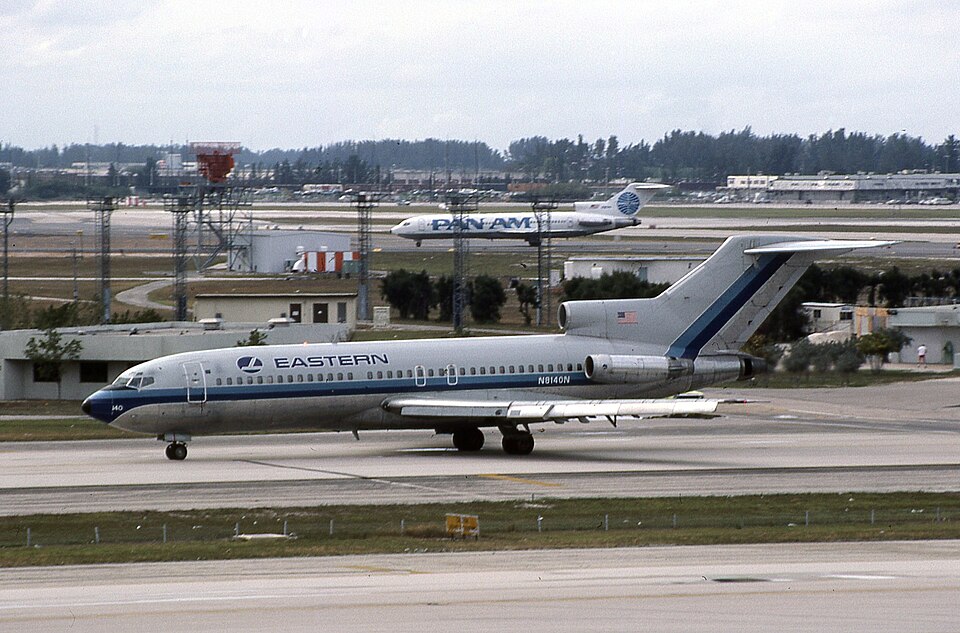
The National Transportation Safety Board determined that the probable cause of the incident was "the failure of the left main landing gear downlock switch which prevented a positive indication that the left main gear was down and locked, and the flightcrew's conviction that the left main gear could not be extended." The Board found that contributing to the incident was "the inability of the second officer to observe clearly and interpret the left gear position indicator alignment through the viewing port."
— NTSB Determination
On April 8, 1981, at about 2003 e.s.t., Eastern Airlines Flight 60, a Boeing 727-25, made an intentional gears-up landing on runway 22R at John F. Kennedy International Airport in Jamaica, New York. The aircraft slid 2,602 feet down the runway before coming to a stop. All 67 passengers and 6 crewmembers evacuated safely using emergency procedures, and there were no injuries.
### The flight
Flight 60 was a regularly scheduled passenger flight from New Orleans, Louisiana, to New York. The aircraft, registration N8140N, carried 33,000 pounds of fuel and departed at 1540. The flight proceeded uneventfully until its descent into the New York area, where it received clearance for an approach to runway 22 left at about 1910. The flightcrew consisted of a captain, a first officer, and a second officer, all of whom were properly certificated and qualified.
### The sequence of events
During the approach, the first officer was flying the aircraft from the right seat. When the captain moved the landing gear lever to the down position, the nose gear and right main gear green indicator lights illuminated, but the left main gear green light did not. The captain retracted and extended the gear again during the final approach with the same result. The first officer executed a missed approach, and the flight was radar vectored to a holding area clear of traffic.
The captain and second officer reviewed the flight manual's abnormal procedures for a landing gear unsafe indication. The gear unsafe warning horn sounded when the throttle was retarded to idle, and no red lights were illuminated. The crew used the test circuit, which verified that the indicator bulbs and circuits were intact.
Following the checklist, the second officer went to the passenger cabin to observe the main landing gear through direct vision viewing ports located in the floor. Passengers observed him pulling up the carpet. The second officer stated he had difficulty raising the carpet and holding it out of the way. He reported seeing the visual "gear down and locked" indicator properly aligned on the right main gear. On the left gear, however, he stated he saw only "a lot of metal" and could not see the position indicator. He assumed the gear had not extended and the door remained closed.
The captain and second officer then attempted to extend the left main gear using the manual release system handcrank. They encountered stiff resistance to rotation in the uplock release direction and could not turn the crank more than about two turns. Both stated they never attempted to rotate it in the opposite, downlock direction.
The captain contacted an Eastern Airlines technical service representative in Miami via radio. They reviewed the procedures, and the crew repeatedly attempted to lower the left gear both hydraulically and manually. The left gear green light never illuminated. The second officer returned to the cabin to check the top of the wing for structural damage, but he did not attempt to look through the floor viewing port again.
About 1940, the first officer asked Approach Control how long it would take to foam the runway. Approach Control advised that the crash fire unit would need 1 1/2 to 2 hours to foam 4,000 feet of runway. The captain determined that the 7,500 pounds of remaining fuel would not permit holding for that long.
The flight attendants prepared the cabin for a gears-up landing. At about 2000, the captain flew the final approach. The aircraft touched down at about 115 knots, 85 feet from the displaced threshold on runway 22 right. The crew shut down the engines, and the passengers and crew evacuated using all exits, including the aft ventral airstair door.
### What the investigation found
Damage to the aircraft was confined to the lower fuselage skin, formers, keel beam, inboard landing gear doors, and flap trailing edges. Because of the intentional gears-up landing, all three landing gears were in the stowed position in the wheel wells.
When the aircraft was lifted off the runway by cranes, a Safety Board investigator rotated the left main gear manual extension handcrank. After about 1 3/4 turns against increasing resistance, the investigator heard a "thud," the resistance eased, and the gear fell free. The crank then rotated six turns without resistance, and the gear locked down normally. Subsequent tests of the hydraulic and manual extension systems on jacks revealed no abnormalities.
Examination of the manual extension cable drum revealed a scored notch between two cable grooves and a worn flat spot on the cable guard. Tests demonstrated that if the handcrank was rotated in the downlock direction while the gear was already down and locked, the cable could slacken, move out of the groove, and jam under the guard. Because the second officer stated he never rotated the crank in that direction, the Board was not able to determine if the manual system functioned abnormally or if the cable moved out of the drum during the crew's attempts to lower the gear.
Investigators removed the left main landing gear downlock-actuated switch assembly. Bench tests and altitude chamber tests simulating a cold-soak at 35,000 feet showed that the switch operated intermittently and unreliably. Disassembly revealed a black coating on the contacts, identified as predominantly silicone, a compound used as a lubricant on the switch seals. The Board noted that this high electrical resistance would prevent current flow, stopping the operation of the indicator lights and the horn relay. The investigation also found that other Eastern Boeing 727-25 flightcrews had recently reported similar gear downlock switch malfunctions.
Examination of the visual indicator in the wheel well showed that the red alignment marks were in good condition, but grease and dirt deposits covered the white background. The Board noted that the second officer's failure to observe the alignment was likely due to the difficult viewing position, dirt on the indicators, possible glare, and his lack of knowledge of what could be seen when the gear was up and locked.
The Safety Board believed that the left main gear was properly down and locked during the approach, but the malfunctioning switch caused the loss of proper gear indications. The Board concluded that the captain made a proper decision to land with the gears up based on the evidence available to him.
### Probable cause
The National Transportation Safety Board determined that the probable cause of the incident was "the failure of the left main landing gear downlock switch which prevented a positive indication that the left main gear was down and locked, and the flightcrew's conviction that the left main gear could not be extended." The Board found that contributing to the incident was "the inability of the second officer to observe clearly and interpret the left gear position indicator alignment through the viewing port."
A SkyWalk Join't 3 paraglider crashed into the ground near Las Vizcachas, Chile, on September 1, 2024. The pilot and passenger sustained serious spinal…
A Cessna 172N struck electrical cables while on final approach to land at Aucó Aerodrome in Chile. The pilot was uninjured, but the aircraft sustained damage…
A Bombardier DHC-8-402 suffered a tail strike during landing at Puerto Williams on September 9, 2024. All 76 occupants were unharmed, but the aircraft…
A MYD JS-MD 3 glider veered off the runway and struck a wall at Vitacura Aerodrome on January 6, 2025. The pilot was uninjured, but the aircraft sustained…
A recreational paraglider flight in Puchuncaví, Chile, ended with the pilot sustaining serious injuries after a rapid descent and impact with a hillside on…
A Tecnam P2006T landed on its belly at an aerodrome in Poland after the crew failed to confirm landing gear deployment. The incident resulted in no injuries…