Incident Summary
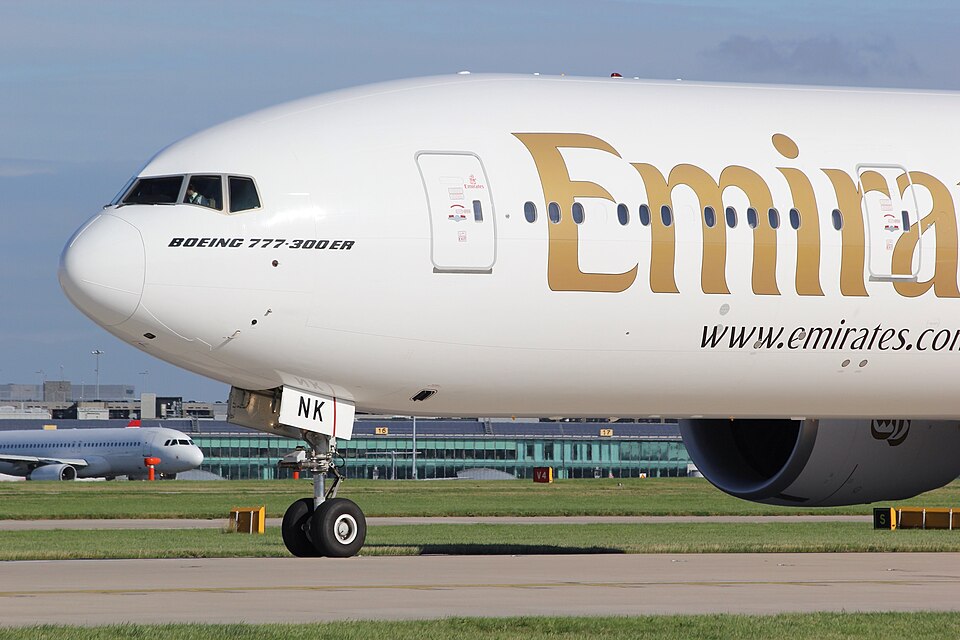
On 19 October 2013, a Boeing 777-300, registration A6-ENK, operating as Emirates Airline flight EK089 from Dubai to Geneva, struck a jetblast fence and a light pole during pushback from Stand G17 at Dubai International Airport. The occurrence was classified as an incident by the Air Accident Investigation Sector (AAIS).
Aircraft and Operator Information
The aircraft was a Boeing 777-300 with manufacturer serial number 38991, powered by two GE90-115BL1 turbofan engines. It was operated by Emirates Airline and registered in the United Arab Emirates. The flight was a scheduled commercial passenger service.
Sequence of Events
Before pushback commenced, the Pushback Operator (PBO) and the Headset Mechanic (HM) were both in the tug cab. The PBO, concerned about nearby aircraft on adjacent Stand G18, planned to turn the aircraft left early to avoid wingtip contact. The HM remained in the tug cab throughout the pushback and pull forward. From their position in the tug cab, neither the PBO nor the HM could observe the aft fuselage or tail area.
After the aircraft was pushed approximately 10 to 15 feet along the stand centerline, the PBO began turning the aircraft left, off the centerline. As the push continued, the aircraft moved onto a collision course with a jetblast fence protecting a service roadway at the ramp edge. The aft fuselage contacted and overrode the fence, followed by the right-hand horizontal stabilizer striking a light pole on the far side of the service roadway.
The pushback crew did not notice the contact. The aircraft was pulled forward to the engine start position, disconnected from the tug, and began to taxi. A ground handling agent driving a lower deck loader along the adjacent service road witnessed the incident and alerted airline personnel. The flight crew was advised, and the aircraft taxied to Stand G04, where passengers and crew disembarked. There were no injuries to those onboard.
Damage
The lower aft fuselage sustained damage, and two static discharge wicks were dislodged from the right-hand horizontal stabilizer. A section of the upper deflector vane of the jetblast fence was damaged, and the light pole was bent.
Investigation Conclusion
The investigation concluded that the incident occurred because the PBO did not remember the details of the non-standard pushback procedure for Stand G17. A period of approximately nine weeks had elapsed between when he had read the procedure and the first occasion he was required to use it. The report includes one safety recommendation addressed to the ground handling agent, in addition to safety actions already taken by involved parties.