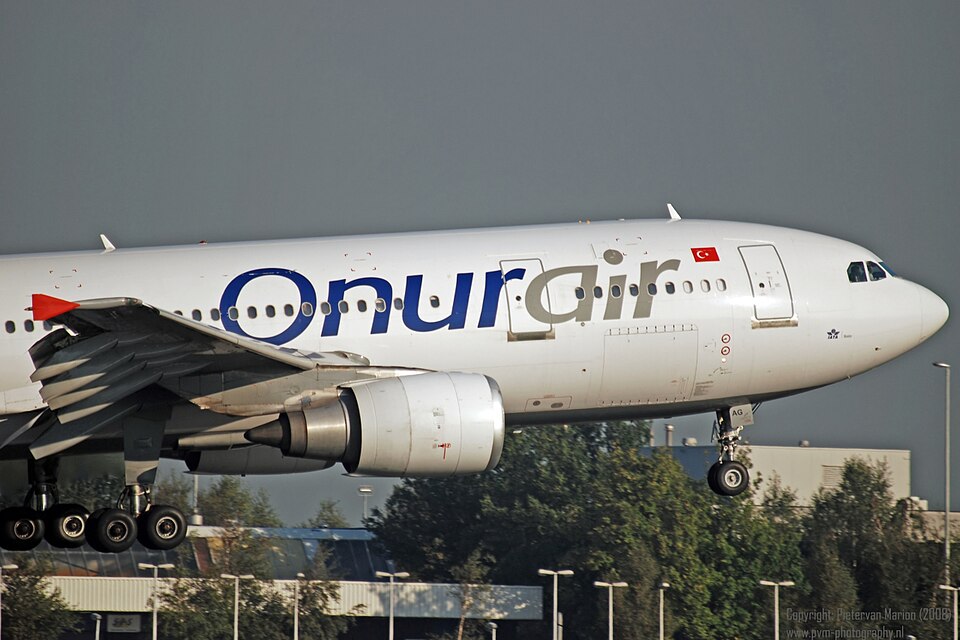
Incident Overview
On 1 May 2012, an Airbus A300-605R registered as TC-OAG, operating as Saudi Arabian Airlines flight SVA2865, experienced a nose landing gear malfunction during approach to King Abdulaziz International Airport (KAIA) in Jeddah, Saudi Arabia. The aircraft was on a positioning flight from Prince Mohammed Bin Abdulaziz International Airport in Madinah, carrying 10 crew members and no passengers. The flight departed at 08:50 local time with no pre-departure discrepancies. Weather at Jeddah was reported as good visibility with few clouds.
Sequence of Events
During the initial ILS approach to runway 16R, at 8 nautical miles and 2600 feet, the landing gear handle was lowered. Both main landing gear extended and locked, but the nose gear doors opened while the nose landing gear did not lower. The captain, then serving as pilot monitoring, took control and executed a missed approach. The first officer became the pilot monitoring. Air traffic control directed the aircraft to an area northeast of Jeddah for attempts to lower the nose gear. The flight crew performed at least ten manual free-fall attempts, but the nose gear remained retracted with doors open.
As a precaution, the crew conducted a fly-by of runway 16R at 500 feet. Air traffic control confirmed the nose gear was not down. The aircraft was vectored over the Red Sea to reduce fuel load and landing weight. Meanwhile, fire and rescue services at Jeddah foamed a portion of runway 16L between taxiways K5 and K2, with the majority of vehicles stationed at the junction of taxiways K4 and K3.
The crew was vectored for an instrument approach to runway 16L, with autopilot and autothrottle systems off. Surface winds were from 220° at 12 knots, gusting to 19 knots, with a temperature of 37°C. The flight crew used the "Landing with Nose Landing Gear Abnormal" checklist to prepare for landing, flare, touchdown, and post-landing procedures.
The aircraft touched down on its main landing gear 4000 feet past the threshold of runway 16L. The nose was slowly lowered, with the nose gear doors contacting the runway within the foamed area, 4500 feet from the end of the runway. The front fuselage then contacted the runway within the last portion of foam, 3500 feet from the end. Sparks were observed as the nose area slid until the aircraft came to a full stop 1500 feet before the runway end.
Fire and rescue vehicles chased the aircraft and reached it within 30 seconds after it stopped. Although no post-crash fire occurred, crews applied water and foam to the nose area. All crew members evacuated via a ladder provided by rescue services and were taken to the airport clinic as a precaution; all were released the same day. The accident occurred at 14:49 local time on runway 16L at KAIA Jeddah.
Cause
The official investigation determined that the nose landing gear up-lock contained a spring (part number GA71102) that was broken due to fatigue initiated at the third coil. The spring had been broken for a prolonged period, as evidenced by linear wear marks. Damage to the up-lock resulted from hard contact with the broken spring during normal operation. Fatigue striation measurements estimated at least 6000 cycles of fatigue. The crack started on the internal surface of the spring, which was not shot peened. Both normal and free-fall extensions of the nose gear failed because of a mechanical blockage created by the broken spring jammed against the cam.