Accident Details
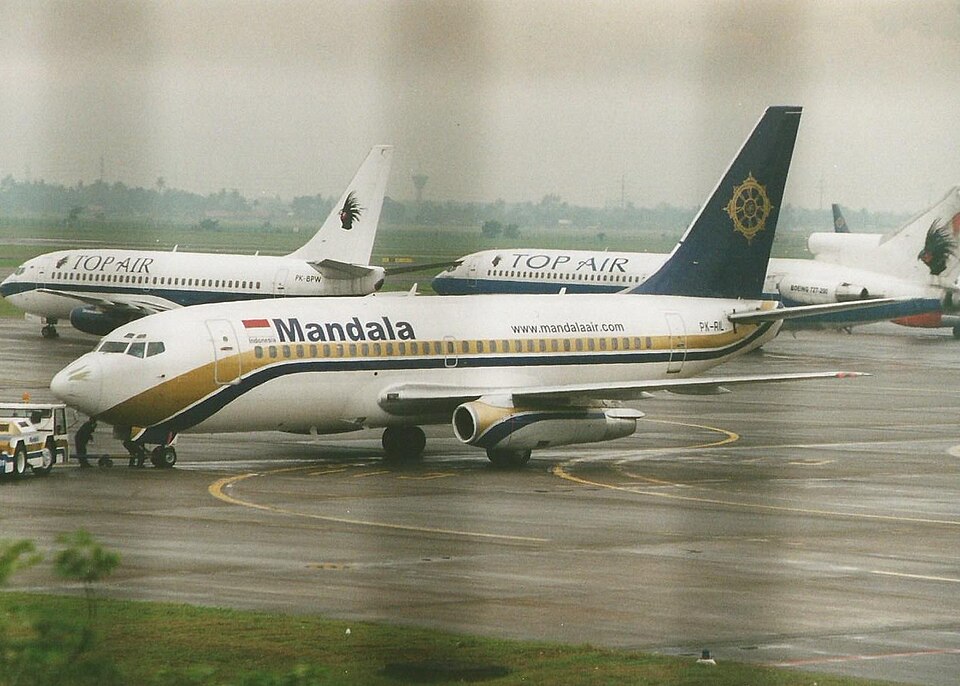
On 1 November 2007, a Boeing Company B737-200 aircraft, registered PK-RIL, operated by PT. Mandala Airlines as flight number MDL 260, was conducting a scheduled passenger flight from Jakarta Soekarno-Hatta International Airport to Abdurrachman Saleh Airport, Malang, East Java. The flight crew consisted of a pilot in command (PIC), who was the handling pilot, and a copilot serving as the support/monitoring pilot. There were 94 persons on board, including two pilots, three cabin crew, and 89 passengers.
Sequence of Events
The aircraft landed at Malang at 1324 Western Indonesian Standard Time (06:24 UTC). It was reported to have been raining heavily when the aircraft touched down on runway 35. During the visual segment of the landing approach, the crew realized that the aircraft was too high with reference to the precision approach path indicator (PAPI) for runway 35. The PIC increased the aircraft's rate of descent (ROD) to capture the PAPI. The high ROD was not arrested, resulting in a severe hard landing. The aircraft bounced twice after the initial severe hard landing.
Damage
The lower drag strut of the nose landing gear fractured, causing the rearwards collapse of the nose landing gear and separation of the lower nose landing gear shock strut and wheel assembly. The aircraft's nose then contacted the runway. The aircraft came to rest 290 metres before the departure end of runway 17. The aircraft sustained substantial damage. No passengers or crew were injured.
Crew Actions
The crew reported that during the approach, they realized the aircraft was too high relative to the PAPI. The PIC increased the rate of descent to correct this. Neither pilot responded appropriately to the ground proximity warning system voice aural 'SINK RATE' or 'PULL UP' warnings that sounded during the final approach. The PIC did not initiate action to recover from the high bounced landing following the initial severe hard landing impact. Additionally, the PIC did not ensure effective crew coordination during the landing approach.
Probable Cause (Official Findings)
The flight crew did not appear to have an awareness that the aircraft was above the desired approach path to runway 35 at Malang until they sighted the visual approach slope indication lighting system. The pilot in command continued the approach in reduced visibility and heavy rain; marginal visual meteorological conditions. Non-adherence by the flight crew to stabilized approach procedures, which resulted in the initial severe hard landing at Malang, together with the omission of a high bounced landing recovery, resulted in substantial damage to the aircraft. The following findings were identified:
- The PIC allowed the approach at Malang to become unstabilized and did not correct that condition.
- The PIC continued the approach in reduced visibility and heavy rain; marginal visual meteorological conditions.
- Neither pilot responded appropriately to the ground proximity warning system voice aural 'SINK RATE' or 'PULL UP' warnings that sounded during the final approach to Malang.
- The PIC did not initiate action to recover from the high bounced landing following the initial severe hard landing impact.
- The PIC did not ensure that effective crew coordination was maintained during the landing approach.