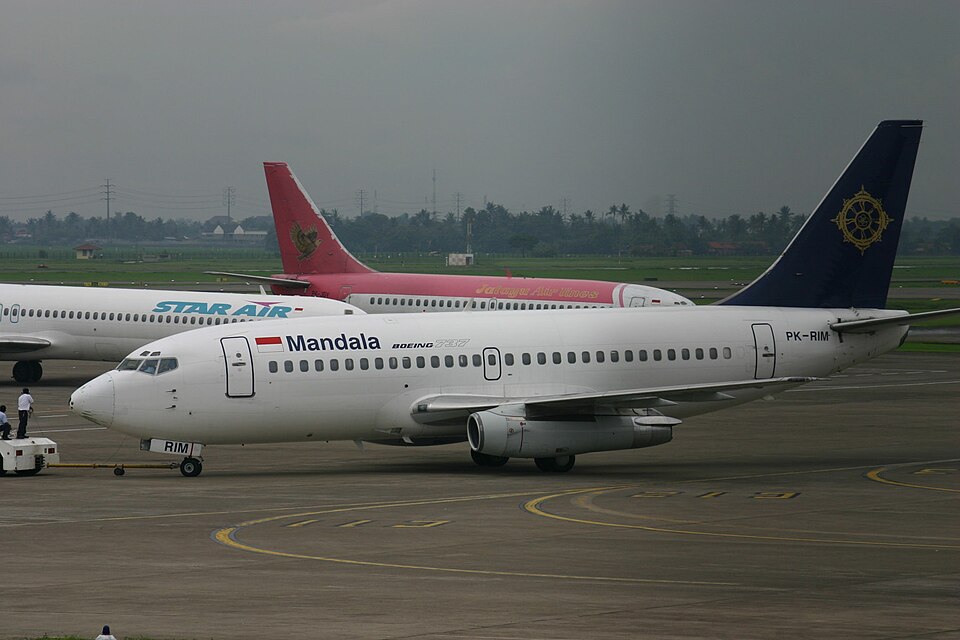
Incident Overview
On September 5, 2005, at 03:15 UTC, Mandala Airlines Flight MDL 091, a Boeing 737-200 with registration PK-RIM, was involved in a fatal accident while departing Polonia Airport in Medan, North Sumatra. The aircraft was on a scheduled passenger flight bound for Soekarno-Hatta Airport in Jakarta. This marked the second trip of the day for the crew, who had previously completed an uneventful arrival from Jakarta.
Pre-Departure Procedures
At 02:40 UTC, the dispatcher confirmed that all passengers, cargo, and flight documentation were ready. Shortly after, at 02:52 UTC, the flight crew requested pushback and engine start clearance from Air Traffic Control (ATC). Following approval, engines were started. By 02:56 UTC, ATC cleared the aircraft to taxi into position on Runway 23 via Alpha.
Takeoff and Deviation
At 03:02 UTC, MDL 091 received takeoff clearance with instructions to turn left to a heading of 120 degrees and maintain an altitude of 1,500 feet. An initial readback error regarding the altitude was corrected by ATC, and the crew subsequently confirmed the correct instruction. During the takeoff roll, witnesses reported that the aircraft’s nose lifted earlier than typical for this model, with rotation occurring near the end of the runway. After becoming airborne, the plane veered erratically to the left and right before crashing into a building and a busy road, resulting in two large explosions and visible flames.
Casualties and Investigation Findings
The accident resulted in significant loss of life. All five crew members and 95 passengers on board perished. On the ground, 49 people were killed and 26 others sustained serious injuries. Two passengers, a mother and her child, survived without injury.
The National Transportation Safety Committee identified the probable causes as an improper takeoff configuration with retracted flaps and slats, which prevented the aircraft from lifting off correctly. This was attributed to improper execution of checklist procedures that failed to identify the flap position. Additionally, the takeoff warning horn did not sound on the CVR’s CAM channel, suggesting a potential failure of the configuration warning system.