Flight Details
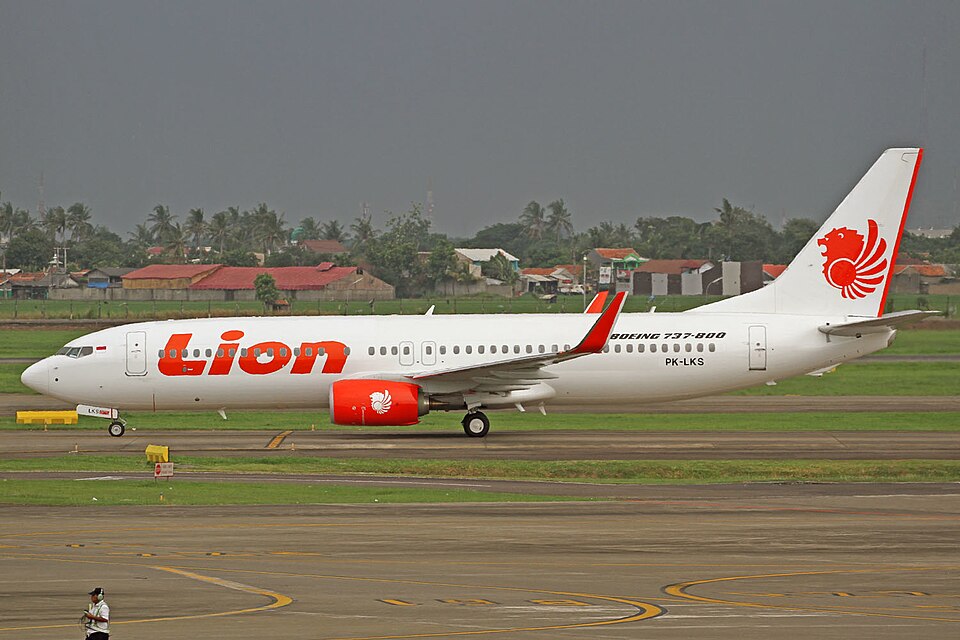
On 13 April 2013, a Boeing 737-800 registered PK-LKS operated by PT. Lion Mentari Airlines (Lion Air) as flight LNI 904 departed Husein Sastranegara International Airport, Bandung at 0545 UTC for Ngurah Rai International Airport, Bali. The flight was the last of four scheduled legs for the crew that day. On board were 2 pilots, 5 flight attendants, and 101 passengers (95 adults, 5 children, 1 infant), totaling 108 persons. The aircraft flew at FL 390, with the Second in Command (SIC) as Pilot Flying and the Pilot in Command (PIC) as Pilot Monitoring.
Sequence of Events
The flight was uneventful until the approach into Bali. At 0648 UTC, the pilot contacted Bali Approach controller when 80 Nm from BLI VOR, receiving clearance to proceed direct to TALOT and descend to 17,000 feet. Further clearances directed the aircraft to KUTA point and descent to 8,000 feet, then vectored for a VOR DME approach to runway 09 with descent to 3,000 feet. Communications transferred to Ngurah Tower at 0703 UTC. At 0708 UTC, landing clearance was issued with wind information. At 0708:47 UTC, the EGPWS called "ONE THOUSAND". The SIC stated "one thousand, stabilized, continue, prepare for go-around missed approach three thousand." The autopilot was used until disengagement. At 0708:56 UTC, at about 900 feet AGL, the SIC commented the runway was not in sight, while the PIC said "OK. Approach light in sight, continue." At 0709:33 UTC, after the EGPWS "MINIMUM" alert at about 550 feet AGL, the SIC disengaged autopilot and auto-throttle. At 0709:43 UTC, "THREE HUNDRED"; at 0709:47 UTC, a sound similar to rain hitting the windshield; at 0709:49 UTC, "TWO HUNDRED". At 0709:53 UTC, at about 150 feet AGL, the PIC took over control; the SIC handed over and stated he could not see the runway. At 0710:01 UTC, after "TWENTY", the PIC commanded a go-around. At 0710:02 UTC, the aircraft impacted the water short of the runway, stopping about 20 meters from shore, approximately 300 meters south-west of the beginning of runway 09. Between 0724-0745 UTC, other aircraft operated. The airport closed from 0750 to 0850 UTC. By 0755 UTC, all occupants were evacuated; injured passengers were taken to hospitals, uninjured to the airport crisis centre.
Investigation Findings
The National Transportation Safety Committee (NTSC) noted: the aircraft was airworthy prior to impact (with one deferred maintenance item category C for right engine oil filter); all crew had valid licenses; the SIC was Pilot Flying; a VOR DME approach with MDA of 465 ft AGL was flown; flap 40 was used; at 900 ft AGL the PF lacked visual contact; at MDA the flight profile showed a constant path; the PIC took control at about 150 ft radio altitude; the SIC handed over and stated inability to see the runway; the final approach was outside EGPWS warning envelope, so no warning was recorded. The NTSC concluded the accident was caused by: the flight path becoming unstable below MDA with rate of descent exceeding 1000 fpm, recognized by both pilots; loss of situational awareness regarding visual references after entering a rain cloud below MDA; the PIC's decision to execute a go-around at an altitude insufficient for successful completion; and the pilots not receiving timely and accurate weather information despite rapidly changing conditions.