Incident Overview
On a cargo flight designated DLH8457 from Sharjah, U.A.E., to Frankfurt, Germany, the crew reported no unusual conditions aside from a few known defects noted by the previous crew. After normal pre-departure checks and an external inspection, the aircraft was cleared to taxi to runway 30 at 1623:24 hr. The crew calculated decision speeds for a reduced-thrust 10° flap takeoff: V1 162 KIAS, Vr 174 KIAS, and V2 180 KIAS.
Takeoff and Abort
The aircraft lined up for a full-length takeoff and received clearance at 1631:42 hr. Surface wind was reported as 340°/08 kt. The takeoff roll began at 1633:32 hr. At 1633:57 hr, the first officer called 80 KIAS, followed by V1 26 seconds later. Simultaneously, the tower controller transmitted, “and Lufthansa there was a bang and you’ve got smoke coming on the right hand side.” The commander aborted the takeoff at 1634:26 hr, maintaining runway centerline. At the time abort actions were initiated, the aircraft speed was 165 KIAS. The crew applied idle power, full reverse thrust, speed brakes, and manual braking. Despite these actions, acceleration continued to 171 KIAS before deceleration began, but the aircraft could not stop within the available accelerate-stop distance.
Runway Excursion
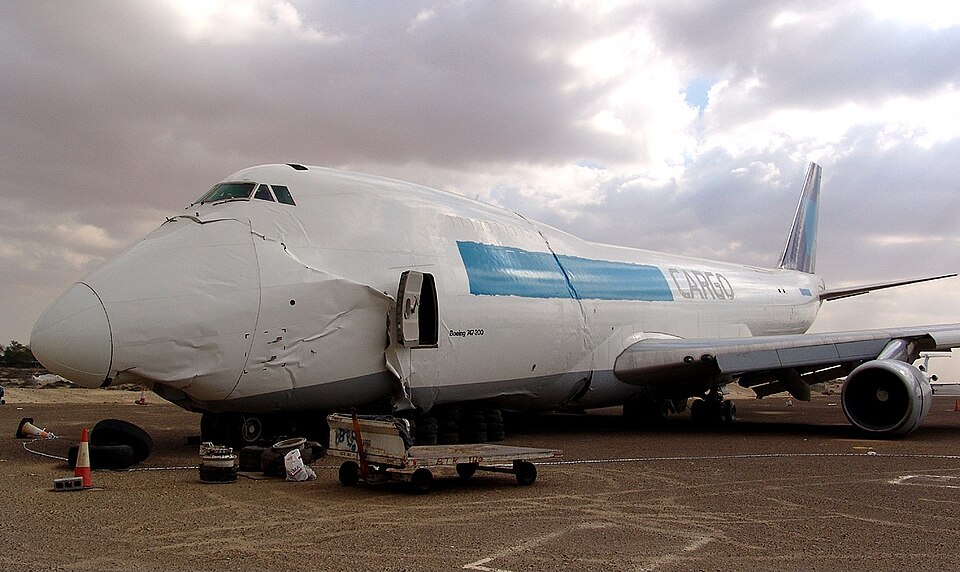
Shortly before reaching the runway end, the commander turned left to avoid elevated approach lights. The aircraft came to rest in an open sand area about 30 meters from the prepared runway surface, in a nose-low attitude. The commander ordered an evacuation, and the crew exited via the right upper deck door using ladders provided by airport rescue and firefighting services.
Investigation Findings
The investigation determined that the abort was initiated above V1 with insufficient runway remaining due to the commander’s interpretation that smoke indicated a fire. A contributory cause was the failure of the No. 9 wheel rim during the takeoff roll, which produced the bang and smoke. Additionally, the probable use of water mist to cool hot brakes may have weakened the wheel rim, and the continued use of the inboard wheel half, which should have been retired during the year 2000, also contributed.