Incident Overview
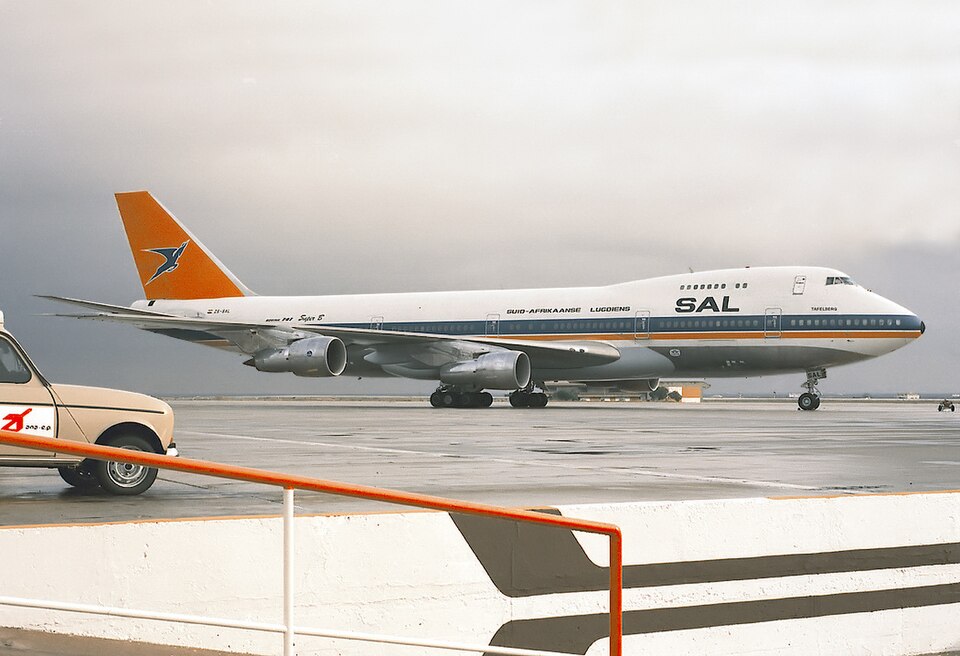
On 2 April 2000 at 2139 UTC, a Boeing 747-200, registration ZS-SAL, experienced a wheel failure while taxiing for departure at London Heathrow Airport. The aircraft, operating a public transport passenger flight, had completed a daily check that included visual inspection of wheels, tyres, and brakes, all of which were found satisfactory.
During taxi towards the holding point for Runway 9R, conducted at speeds no higher than 9 kt, the crew heard a loud bang and felt a slight bump. Almost immediately, all anti-skid warning lights associated with the right wing landing gear illuminated. A passenger informed cabin crew that a tyre had rolled from under the aircraft across the grass between the taxiway and runway. The aircraft stopped at the holding point and was inspected. It was evident that the inboard rim of the No. 2 wheel (front inboard wheel of the left wing landing gear) had completely detached, allowing the tyre to come off. After replacing wheels Nos. 1 and 2, the aircraft was towed back to the gate, where passengers disembarked normally.
Secondary Damage
Further examination revealed that fragments of the failed inboard rim had been jettisoned and caused impact damage to the right main gear door, the right wing landing gear, and its folding door. A wiring conduit mounted on the right wing gear drag brace, containing anti-skid unit wiring, was severed in two places. The No. 2 wheel, tyre, and rim fragments were collected and taken to the AAIB for detailed examination.
Wheel Examination
The tyre was intact and in good condition with no unusual damage. The wheel consisted of inboard and outboard wheel halves bolted together. The fracture occurred where the inboard side rim adjoined the cylindrical section of the wheel hub. The rim fractured into three sections, each weighing between 3 and 6 lbs. Metallurgical examination found all fracture surfaces exhibited characteristics of a single event overload, initiated by a high-cycle tension fatigue crack in the bead radius of the rim, extending over approximately 4 inches. The crack likely initiated from a single point, possibly a surface defect.
Information from the wheel manufacturer indicated the tyre bead seat radius was a critical area for tension fatigue stresses, and this region was shot peened during manufacture to generate compressive stresses. After cleaning, it was apparent that the peening effect had been polished out over a length of about 9 inches, and the fatigue crack origin was located within this polished band. The polishing removed most of the compressive layer and left scores in the new surface. The fatigue origin was no longer present, indicating the embryonic crack initiated before polishing and was not completely removed.
The Component Maintenance Manual (CMM) recommended eddy current or ultrasonic inspection for cracks in the bead seat radius area and stated no wheel should be returned to service with cracks. Some reworking was permissible, but surface treatment had to be restored.
Additional inspection of the inboard wheel half using the Hocking eddy current method identified several defects and areas of polishing where previously identified defects had been removed.
Wheel History
The failed wheel assembly, Part No 2603561, was an early standard designed for the Boeing 747-200/300. The current standard includes modifications such as a compound bead seat radius for improved fatigue resistance.
At the time of the incident, the failed outboard wheel half (Serial No H192, manufactured October 1995) had accumulated 7,174 cycles and 101 tyre changes. It was last checked for cracks on 7 February 2000 using the Hocking eddy current system, when no cracks were detected, and had since accumulated 84 cycles. The inboard wheel half (Serial No H0003, manufactured December 1977) had accumulated 6,436 cycles. The CMM required wheel halves of that age to be inspected every three months.