Incident Overview
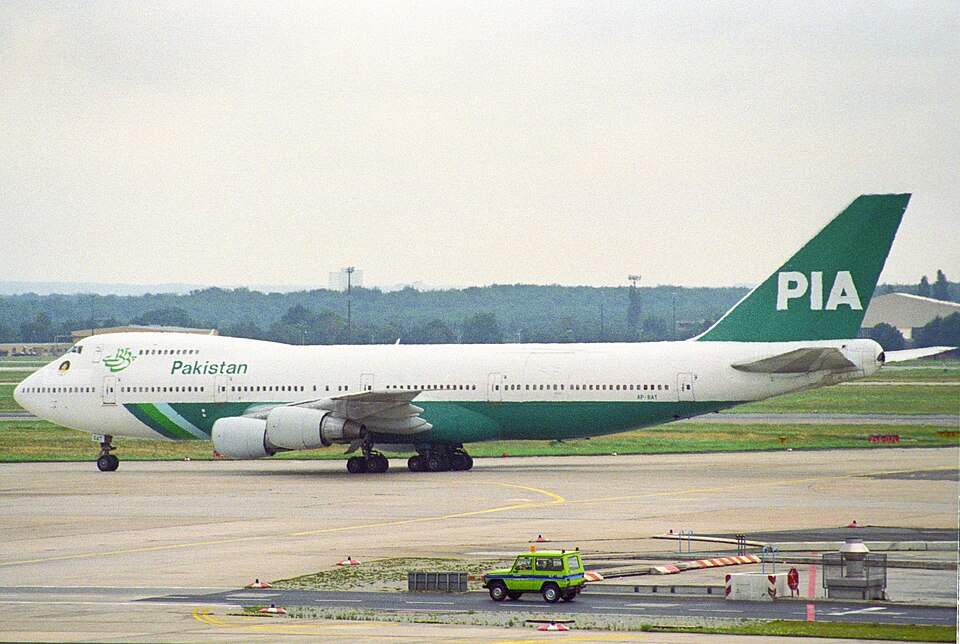
On 13 June 2002 at 0646 UTC, a Boeing 747-240B registered AP-BAT was operating a scheduled public transport flight from New York Kennedy Airport to Manchester International Airport. The aircraft made an uneventful approach and touchdown on Runway 24R. After touchdown, reverse thrust was selected on all four General Electric CF650C2 turbofan engines to approximately three-quarters power. At around 80 knots, reverse thrust was cancelled. The thrust reversers on engines 1, 2, and 4 stowed normally, but flight deck indications showed that the No 3 engine reverser remained unlocked and in transit.
After the 747 landed, a Boeing 757 aircraft was cleared to cross Runway 24R. The first officer of the 757 observed a large piece of engine cowling falling from the 747 during its landing roll and notified Air Traffic Control. ATC took action to prevent other aircraft from landing on the runway and offered the support of emergency services to the 747 commander, which was declined. The 747 continued taxiing to its allocated parking stand, where after engine shutdown the 303 passengers and 16 crew disembarked without injury.
Airport and System Information
Manchester Airport features two staggered parallel operational runways: 24R/06L and 24L/06R, separated by 380 metres. A Runway Incursion Monitoring (RIM) system using ground movement radar is installed on Runway 24R/06L. Although the RIM system was not necessary on this occasion due to the pilot report, recorded data reviewed later showed that the detached transcowl would have triggered an automatic alert if an aircraft had been on final approach.
Flight Recorder Data
The cockpit voice recorder had a half-hour duration and had overwritten after the event. The flight data recorder indicated an uneventful touchdown at 133 knots. Peak N1 values for engines 1 through 4 were 94%, 78%, 95%, and 89% respectively. No anomalies were recorded during reverse thrust selection. Reverse was cancelled at 90 knots on engines 2 to 4 and at 68 knots on engine 1. Normal stowage was evident for engines 1, 2, and 4, but the engine 3 reverser in-transit and unlocked discrete parameters remained active for the rest of the recording.
Engineering Examination
The separated component was identified as the outboard half of the No 3 engine thrust reverser translating sleeve (transcowl). Also recovered from the runway were several small pieces of debris, including the lower screwjack clevis fitting. The transcowl had separated from the C-duct and carried four blocker doors with it. All three clevis fittings had separated from the transcowl; the upper fitting remained attached to its screwjack, while the lower and centre clevis attachment pins had fallen out. The upper slider fitting on the transcowl was bent upwards and slightly outboard, consistent with the transcowl pivoting aft and upwards about the midpoint of the upper slider.
All three screwjacks remained attached to the C-duct. The upper and lower jacks were almost fully retracted. The centre jack was about halfway retracted with a moderately bent shaft, causing seizure of the nut tube on the screw. Wear marks on the cascades indicated that the centre jack had rotated while unattached to the clevis fitting and after it became bent. Light wear marks were present at the position of the upper screwjack where the clevis fitting had been drawn across the cascades after separation. Wear marks on the cascades at the lower screwjack and on the inner surfaces of its clevis fitting were consistent with persistent rubbing over many reverser deployments.
Examination of the lower clevis fitting showed that the tails of the four solid flange-to-skin attachment rivets were still retained in their holes, and all four had failed in shear in a consistent direction.
Historical Context
The thrust reverser system on CF6-50C2 engines has been in service for over 30 years on various aircraft types. Although generally robust and reliable, the system has experienced a considerable number of transcowl detachment events, typically occurring during stowage after reverse thrust application. The underlying cause of most such events has been attributed to misrigging or incorrect maintenance/lubrication, leading to abnormally high loads during translation. Correct rigging of the translation mechanism is critical, as skewing can cause jamming; in such cases, the pneumatic motor is powerful enough to break other parts, leaving the transcowl partially restrained and liable to separate.
In the late 1980s, the engine manufacturers initiated a campaign to reduce the rate of transcowl liberations, including maintenance education and the issuance of Commercial Engine Service Memorandums (CESM 75 for CF6-6 and CESM 76 for CF6-50). These measures, along with hardware and procedure changes, resulted in a marked decrease in such events. The most common failures involved flexible driveshafts and screwjacks. A previous clevis fitting attachment failure occurred in 1987 and was associated with a lower flexshaft failure. The two most recent transcowl separations prior to this incident (December 1993 and December 1996) were attributed to failure of the bond between the honeycomb panel and its skins, with the lower clevis fitting fracturing in those events.