History of the Flight
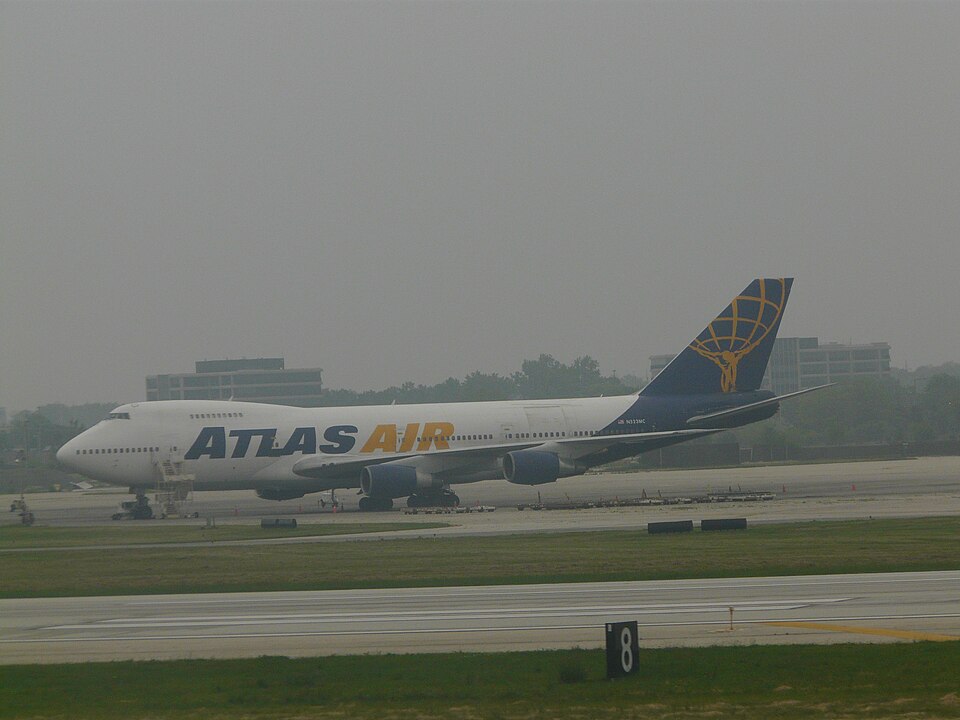
On 12 December 2004, a Boeing 747-2D7B (registration N523MC) operated a cargo flight from Chicago O'Hare to London Stansted. The crew consisted of three members. Departure was delayed by over three hours due to loading issues. During the flight, the commander, acting as handling pilot, briefed for a practice Category II ILS approach and automatic landing on Runway 05.
At approximately 1600 UTC, the aircraft was at FL75 overhead Barkway VOR. Following ATC instructions, the crew descended to 6,000 ft on a heading of 050°M. Subsequent vectors brought the aircraft to 3,000 ft heading 180°M by 1605. At 1607, the controller instructed a left turn onto 020°M and to descend to 2,000 ft. The crew acknowledged. At 1609, they reported established on the localiser. The controller cleared them to descend on the ILS and to contact Stansted Tower. The crew checked in with Tower and reported being on the ILS. At 1610, the aircraft was cleared to land. After landing, it vacated via a rapid exit taxiway.
Inside the cockpit, the commander had selected Flap 20 and gear up for the descent from 3,000 ft. Both autopilots were engaged. During the descent, the co-pilot noticed flags on his instruments indicating loss of localiser and glideslope reception. The commander's instruments showed normal indications. All three crew members discussed the issue and attempted troubleshooting. Shortly afterwards, the aircraft broke cloud at approximately 900 ft amsl, about 6 nm from the threshold. The commander immediately disconnected the autopilots, levelled the aircraft, and executed a gentle climb to intercept the normal glideslope. The crew completed pre-landing checks and landed uneventfully.
After shutdown, the crew made technical log entries noting the autoland was unsuccessful and that the co-pilot's flags were visible until 800 ft. Ground engineers performed a BITE check but could not replicate the fault. The aircraft was released for flight with a request for airborne reports.
The commander did not submit any reports about the incident. The co-pilot reported via NASA ASRS and ASAP. The flight engineer submitted a NASA report. The airport authority learned of the incident only after noise complaints led to a radar recording review. The AAIB was notified on 15 December and began an investigation. The operating company also initiated an inquiry with FAA and NTSB support.
Weather Information
The TAF for Stansted from 1300 to 2200 UTC indicated surface wind 100°/8 kt, visibility 8,000 m, broken cloud at 600 ft agl, with temporary reductions possible. Actual weather at 1550 UTC: wind 100°/9 kt, visibility 8,000 m, scattered cloud at 700 ft and broken at 900 ft. At 1620 UTC: wind 100°/8 kt, visibility 8,000 m, scattered at 800 ft and broken at 900 ft. QNH was 1027 mb.
ATC Information
ATC radio recordings showed all clearances were correctly acknowledged. The Tower controller visually monitored traffic; she obtained visual contact with N523MC at about 3 nm. The AMA monitored lateral position only. Essex Radar controllers were instructed to monitor altitude of aircraft after transfer to Tower, but the controller omitted to do so, assessing his workload as low to medium.
Recorded Information
Due to late notification, the CVR and FDR had overrun and no relevant data were available. Radar data showed the descent from 3,000 ft was at an average angle of 5.4° with a rate of 1,570 ft/min until level off at about 900 ft amsl. The aircraft's path was below the normal glideslope.
Crew Information
The crew were interviewed on 20 December. The commander and flight engineer had been off-duty five to six days before positioning to Chicago. The co-pilot had simulator duties the day before. All were woken at 0330 UTC on the day of the flight. Pre-flight checks were normal. The commander intended to conduct a Category II autoland evaluation; ATC was not informed. During the approach, the crew focused on troubleshooting the co-pilot's flags. No altitude alert was recalled after the descent from 3,000 ft. The aircraft's GPWS did not activate; an AAIB evaluation indicated a Mode 4 alert would have occurred within 6-10 seconds if no action was taken.