Incident Summary
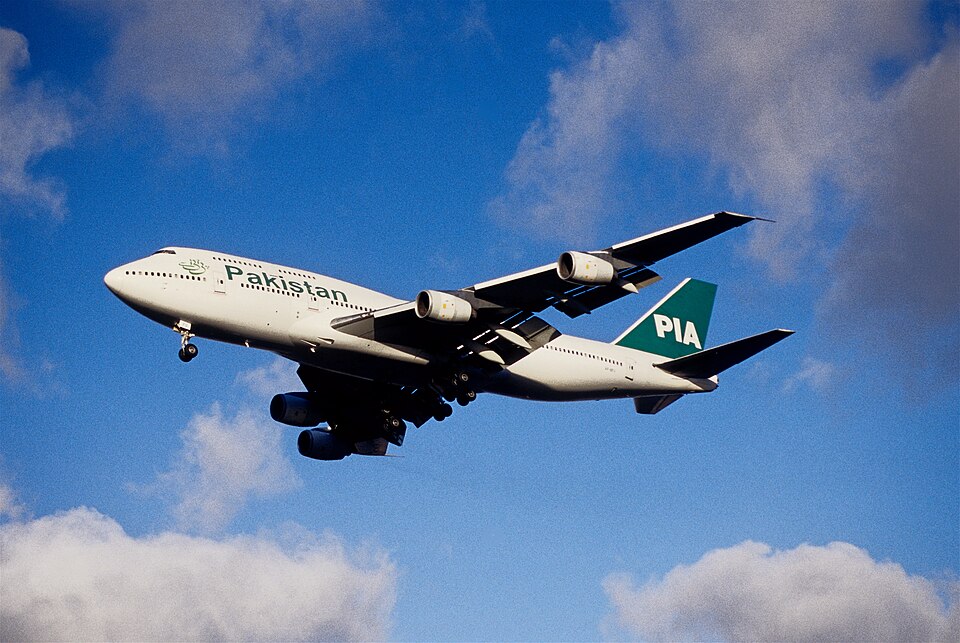
On 7 December 2002, a Boeing 747-367, registration AP-BFV, was taxiing for departure from London Heathrow Airport when the crew heard a bang and felt the nose pitch down. The master warning panel displayed a 'STAB TRIM' caption. The commander cancelled the departure and returned to a stand. An engineering examination revealed that the nose landing gear outer cylinder had suffered a complete circumferential fracture, with a large section of the cylinder ejected onto the taxiway. There were no injuries to the 15 crew or 457 passengers.
Flight Details
The aircraft had pushed back from Stand M30 at 2019 UTC and was cleared to taxi to Runway 09R. Visibility was 4,500 metres in light drizzle, wind 12 kt, temperature 4°C. While turning at Block 104, the crew heard a bang and experienced a pitch-down moment. The 'STAB TRIM' warning illuminated. The commander reported a technical problem and requested an engineer. ATC instructed the aircraft to hold, and debris was later found on the taxiway. The largest piece, approximately 40 cm by 30 cm and 2 kg, originated from the nose landing gear outer cylinder. The aircraft taxied to Stand 34 without further incident.
Wreckage and Metallurgical Examination
A metallurgical examination concluded that the fracture resulted from fatigue initiating at the base of a groove at the upper edge of the internal diameter (ID) seal band. The groove was square in cross-section, resembling a cut from a rotating cutting wheel, and was machined into 70% of the internal circumference. The fracture had propagated through about half of the cylinder wall before final failure. The groove was not part of any design, manufacturing, or overhaul specification. Additional deviations included a blended depression causing localized wall thinning below minimum requirements and areas that had been blended after nickel plating without subsequent shot peening, which increases susceptibility to fatigue.
Maintenance History
The nose landing gear had been overhauled in 1998 at an FAA-approved Repair Station. During that overhaul, the outer cylinder was exchanged from another Repair Station. The outer cylinder had accumulated 12,323 cycles before overhaul and a further 3,655 cycles by the time of the incident. During overhaul, nickel plating was applied, and nickel 'trees' (protrusions) were removed using a hand-held cutting wheel. The Repair Station suggested that misuse of the cutting wheel introduced the groove. Inspection of the ID seal band after rework was done only with a mirror; no profile or ultrasonic thickness measurements were performed.
Previous Occurrence
In June 1998, a Boeing 747-300 experienced a nose landing gear outer cylinder failure while being towed. That cylinder had been overhauled in 1996.