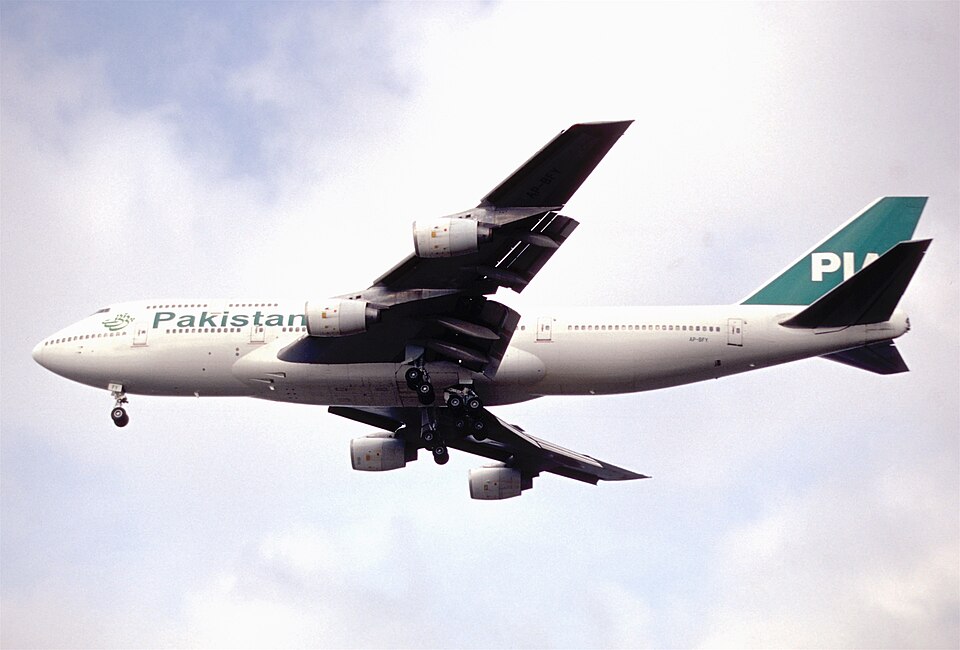
Incident Overview
On 5 September 2000, a Boeing 747-367 (registration AP-BFY) was climbing over the Arabian Sea when the crew detected a medium frequency airframe vibration. All cockpit indications were normal, and the vibration ceased before troubleshooting was complete. The flight continued uneventfully to Manchester.
Flight Details
The aircraft was operating a scheduled passenger service from Karachi to Manchester. The flight crew comprised 18 members with 446 passengers; no injuries were reported. The flight engineer's pre-flight walkaround found no abnormalities.
Inspection Findings
After landing, ground personnel discovered impact damage on the right-wing inboard flaps, adjacent high-speed aileron, and outboard flaps. The movable flap track fairing ("canoe fairing") was broken, and a link attaching the cam track to the main carriage had fractured. The inboard drive rod for the aft flap was bent. On the No 3 engine, scrape marks and indentations were present inside the bypass duct, and both combustion section side fairings on the engine core were missing.
Flight Recorder Analysis
The Digital Flight Data Recorder (DFDR) and Quick Access Recorder (QAR) recorded the flight. No anomalies were found in engine parameters between FL180 and FL220, preventing precise timing of the event. Crew actions during troubleshooting (altering air conditioning pack and autopilot settings) were observed as the aircraft climbed through FL240. The Cockpit Voice Recorder (CVR) retained only the approach and landing, with no relevant conversation.
Engineering Examination
The missing combustion section fairings (part numbers LK70363 and LK70365) cover the core combustion area. Each side fairing is retained by hooks on the top section and latches at the bottom. As the fairings were not recovered, it could not be determined if latches were secure or if mechanical failure occurred. The retained top fairing had intact pins; a bent lug on the left side suggested secondary damage during separation.
Background and Related Occurrences
A Rolls-Royce Service Bulletin (RB211-72-4647) issued in 1977 introduced modified hooks to prevent mal-assembly, but later occurrences were still attributed to incorrect fitting. The UK CAA database records three previous similar detachments; at least one involved modified fairings. Rolls-Royce reported 20 similar incidents up to May 1999, with five or more involving post-bulletin modifications. In one case, a required duplicate inspection was omitted.
The AAIB issued Safety Recommendation 2000-48, urging the UK CAA and Rolls-Royce to review the history of fairing loss and reassess the effectiveness of the current design to prevent mal-assembly.