History of the Flight
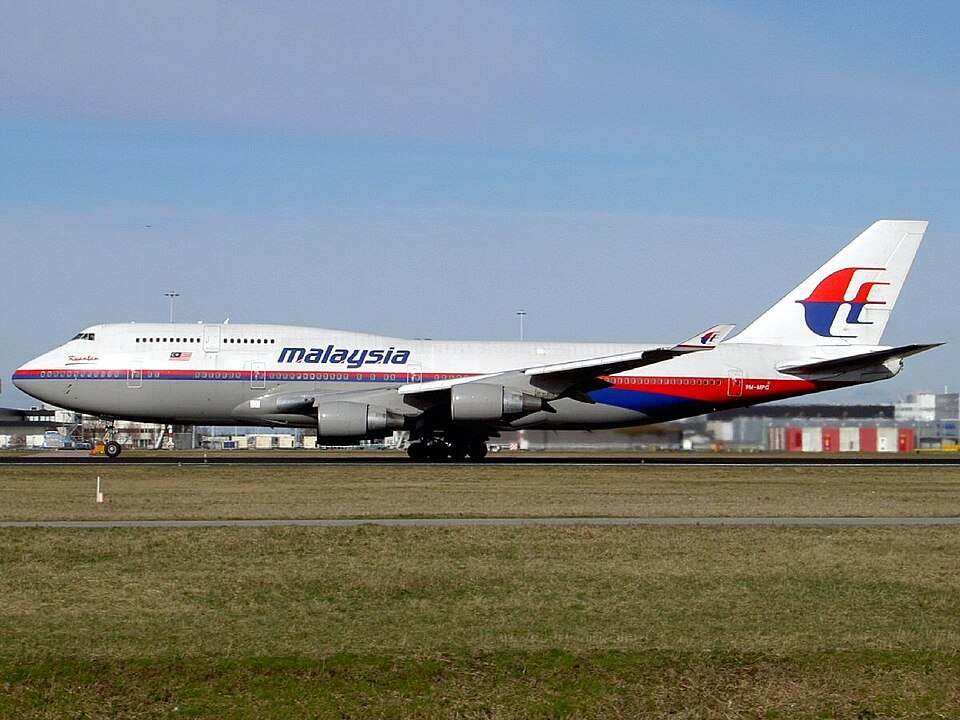
The aircraft, a Boeing 747-400 registered 9M-MPC, was scheduled for a passenger flight to Kuala Lumpur. The flight crew consisted of an operating captain (commander) and a first officer who was experienced as a cruise pilot but relatively inexperienced as a handling pilot for takeoff and landing. A second captain and first officer occupied supernumerary seats.
Normal pre-flight procedures were completed. The commander provided a takeoff briefing emphasizing correct rotation technique and transition to initial climb. For noise abatement, full takeoff thrust was used, and the aircraft was to fly at approximately V2+10 kt until passing flap retraction altitude.
Takeoff weight was 372,304 kg (max permitted 394,625 kg). Fuel on board was 143,500 kg. Takeoff speeds were V1 153 kt, VR 168 kt, V2 177 kt with 20° flap. Surface wind was 200°M at 19 kt, giving a headwind component of 6 kt and crosswind component of 18 kt. The maximum permitted crosswind component for takeoff on a dry runway was 30 kt; company procedures limited first officers to 20 kt crosswind.
The Tower controller passed wind as 210°M at 15 kt at takeoff clearance. Takeoff commenced at 0957 hrs. During acceleration, the commander noted fluctuation in airspeed indication around 100 kt and at V1. Rotation began at VR, but the commander perceived speed increasing toward V2+20 kt. To assist the first officer, the commander made an additional rearward control column input, causing an increased pitch rate. The tail struck the runway as the aircraft left the ground. The stick shaker activated momentarily; a forward input reduced pitch attitude. The aircraft continued climbing, with the first officer adjusting to correct climb attitude. Landing gear was retracted after flight path stabilized at about 1,000 ft agl. ATC reported debris falling from the tail section.
An APU Fire Warning then occurred; the APU fire action was carried out (the APU had been shut down after engine start). The crew followed QRH procedures for APU Fire and Tail Strike on Takeoff. The aircraft was depressurized per Tail Strike procedure, and the commander decided to jettison fuel before returning to Heathrow. Despite previous discharge of the APU fire extinguisher, the warning continued intermittently, which the commander considered spurious due to tail damage.
Cabin crew were informed and positioned at the rear to report abnormal symptoms. The aircraft climbed to FL100, dumped 74,000 kg of fuel, then returned for an uneventful landing on Runway 27R at 1057 hrs with the commander as handling pilot. Landing weight was 283,400 kg (2,300 kg below max landing weight limit). After landing, Airport Fire Service confirmed no smoke or fire, and the aircraft taxied to stand R34. Passengers deplaned normally.
Examination of the Aircraft
Damage to the rear fuselage underside started nearly 20 ft aft of the rear pressure bulkhead, from Frame 2598 to Frame 2764. Frames were buckled; fuselage skin on the centreline had severe abrasion. The forward APU firewall (Frame 2658) and rear firewall (Frame 2742) were buckled and cracked. The left APU access door sheared off at its hinge and was found 3 miles from Heathrow; the right door was mostly torn off and found 13 miles after takeoff. The APU itself was undamaged and there was no fire.
The door contact with the runway disengaged the latching mechanism, allowing doors to rotate outward. Light contact marks and two punctures were found on the fuselage above the APU bay. The doors heavily impacted both inboard elevators (composite construction), causing multiple punctures penetrating to the upper surface.
The APU fire detection loop attached to the doors broke when the doors departed, leaving two cables trailing aft. The bare cable ends chipped paint and could have caused electrical shorting, possibly responsible for intermittent APU fire warnings.
Wind Information
ATIS information code 'Kilo' (0908-0931) indicated surface wind 200° at 15 kt, variable 160°-230°. Code 'Lima' (0931-0957) showed 200° at 16 kt, variable 160°-230°. Code 'Mike' (from 0957) gave 200° at 16 kt, min 11 kt, max 26 kt, variable 170°-230°, with present weather a rain shower. All broadcasts noted possible turbulence on final approach for Runway 27R.
Anemograph data from two sites showed wind direction variation from 200° to 230° at the southwest and 170° to 250° at the northeast. Wind speed varied between 9-24 kt and 12-24 kt, respectively. ATC wind displays from four anemometers provided mean wind averaged over two minutes; information passed to aircraft included 220°/12 kt (0951), 210°/15 kt (0952), and 210°/12 kt (0953). At landing time (1057), wind was 210° at 19 kt.
Wind tunnel tests prior to construction of the World Cargo Centre south of Runway 27L indicated the building's effect on ambient wind conditions was a slight decrease of about 2 kt in wind speed at 1,700 m from the start of the takeoff run, then an increase of 2 kt headwind and 4 kt crosswind at 1,800 m. It was not considered these changes significantly affected takeoff handling or performance in this case.