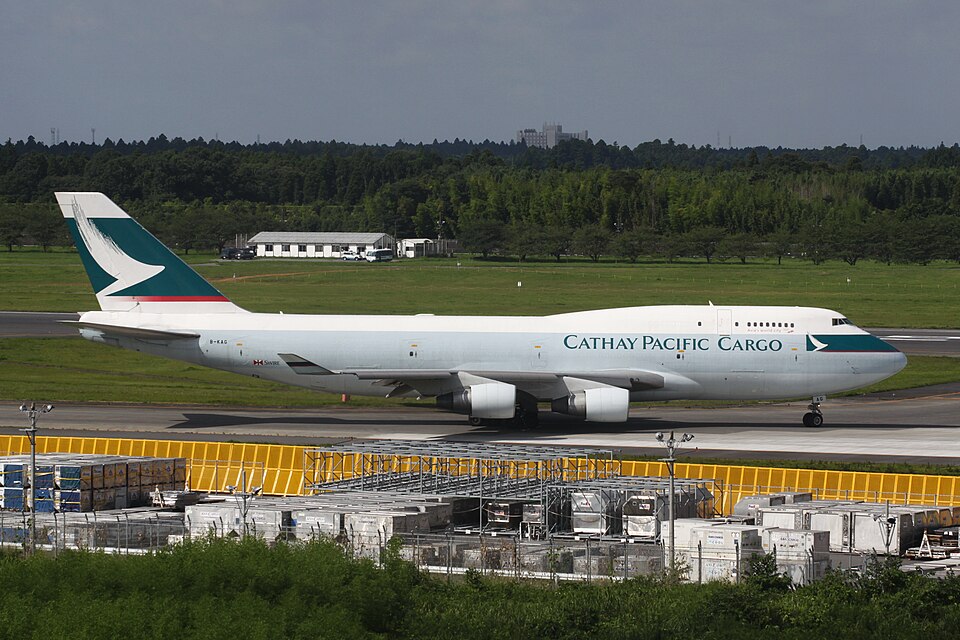
Synopsis
On 1 March 2008 at 0128 hrs, a Boeing 747-412 operated as a scheduled cargo flight from Dubai to Manchester Airport experienced a serious incident during landing. The aircraft, registration B-KAG, sustained damage to the No. 1, 2, and 4 engine nacelles, and a No. 2 main landing gear tyre ruptured. The two crew members were uninjured.
History of the Flight
The crew noted strong winds forecast across northern Europe during pre-flight briefing. The Manchester forecast indicated crosswinds exceeding the co-pilot's 20 kt limit, so the commander acted as pilot flying. They uplifted extra fuel for a potential diversion. En route, they monitored weather and confirmed alternate aerodromes: Nottingham East Midlands as primary, London Heathrow as secondary.
During the first approach to Runway 23R with 30° flap, a windshear warning activated at 500 ft agl. The crew executed a missed approach and requested vectors for a second ILS approach. The second approach was made with 25° flap due to speed fluctuations. Approaching 11 nm, ATC advised that an Airbus A321 had landed successfully. The aircraft was stabilised by 1,500 ft aal. Surface wind reported as 280°/20 kt gusting 36 kt, with subsequent instantaneous readings up to 300°/31 kt. The commander disengaged autopilot and autothrust. Aural alerts included "FIVE HUNDRED", "ONE HUNDRED", "MINIMUMS", and "SINK RATE" warnings. The aircraft landed with a high rate of descent, with the commander recalling 1,100 fpm.
During rollout, ATC reported sparks from both wings and engine contact with the runway. The airport fire service inspected and found damage to Nos. 1 and 4 engine cowlings; no fuel or fluid leaks were detected. The aircraft taxied to stand under its own power.
Meteorology
An area of low pressure north-east of the UK produced strong north-westerly winds. The TAF for Manchester forecast 260°/22 kt gusting 35 kt, with temporary increases to 270°/28 kt gusting 45 kt. ATIS at 0050 hrs reported 280°/25 kt gusting 42 kt, visibility >10 km, few clouds at 2,800 ft, wet runway, and moderate to severe turbulence between 16 nm and 10 nm on approach. ATIS at 0120 hrs reported 300°/28 kt gusting 42 kt, visibility >10 km, few clouds at 3,200 ft, wet runway.
The UK Air Pilot warns pilots of turbulence and large windshear effects when landing on Runway 23R in strong north-westerly winds.
Aircraft Description
B-KAG was a Boeing 747-400 BCF (freighter conversion), serial number 27067, with four PW4056 engines. Wingspan 64.9 m, length 68.6 m. Landing weight 257.8 tonnes (max 295.7 tonnes). CG at 21.1% MAC.
Nacelle Clearance
Engine nacelle ground clearance depends on pitch and bank angles. With MLG shock struts compressed, nominal combinations for nacelle contact are defined. Wing bending due to aerodynamic loads also affects clearance.