Accident Description
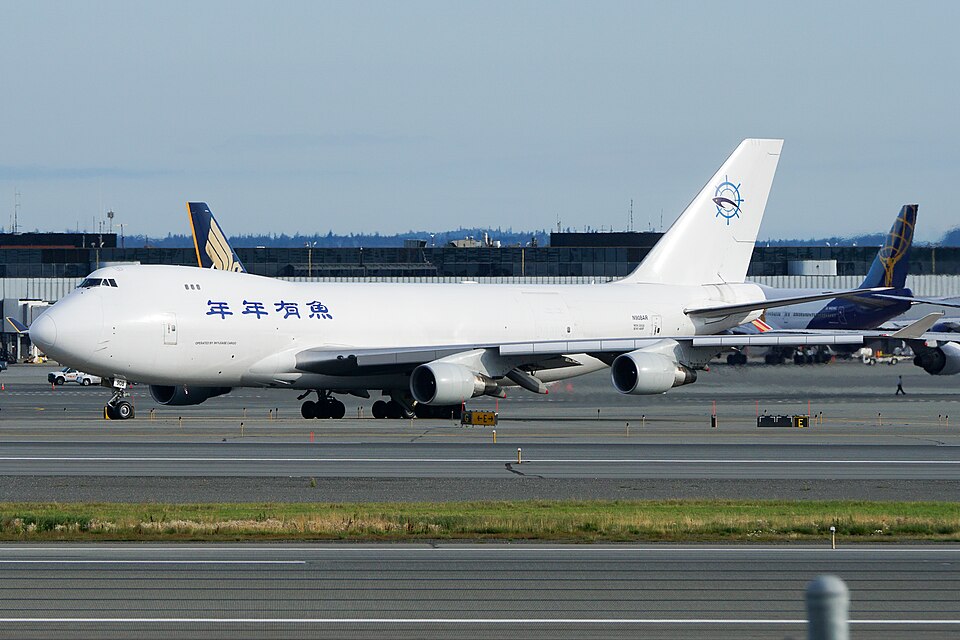
On a dark night at 0506 Atlantic Standard Time, a Sky Lease Cargo Boeing 747-412F (registration N908AR, serial number 28026) operating flight 4854 from Chicago O'Hare to Halifax/Stanfield International Airport experienced a runway overrun after landing on Runway 14. The aircraft had three crew members and one passenger on board, with no cargo. The crew conducted an instrument landing system approach to Runway 14.
Sequence of Events
Approximately 1 minute and 21 seconds from the runway threshold, the crew realized a tailwind was present but did not recalculate landing performance due to limited time. The aircraft touched down firmly. For undetermined reasons, the No. 1 engine thrust lever moved forward of idle, retracting the speed brakes and disengaging the autobrake system. A right crab angle of 4.5° at touchdown, combined with crosswind and asymmetric reverse thrust, caused the aircraft to deviate right of the centerline. The pilot monitoring focused on the lateral drift and did not make required callouts about deceleration devices. Manual braking began 8 seconds after touchdown, but maximum braking effort occurred 15 seconds later when the aircraft was 800 feet from the runway end. The aircraft departed the runway at 77 knots and stopped 270 meters (885 feet) past the end, striking approach light stanchions and the localizer antenna array. The No. 2 engine detached during impact, causing a fire in the tail section. The emergency locator transmitter activated. All three crew members sustained minor injuries and were transported to a hospital; the passenger was uninjured. The aircraft was damaged beyond repair.
Findings
The investigation identified multiple causes and contributing factors, including: misinterpretation of NOTAMs leading the crew to believe Runway 23 was unavailable; the aircraft not meeting pre-departure landing weight requirements for Runway 14 with flaps 25; crew fatigue due to nighttime circadian trough and insufficient sleep; use of unfactored landing distance charts; calculation of a faster approach speed; lack of direct communication of runway change from air traffic control; selection of flaps 25 instead of 30; cognitive biases and fatigue; failure to recalculate performance after recognizing tailwind; elevated stress; higher approach speed and tailwind; undetermined forward movement of No. 1 thrust lever; crab angle and asymmetric reverse; pilot monitoring's focus on lateral drift; and delayed maximum braking. The aircraft crossed a 2.8-meter drop 166 meters past the runway end.
Risk Findings
The investigation noted that if the pilot monitoring does not call out approach conditions or speed increases, the pilot flying might not correct, increasing runway overrun risk.
Other Findings
There was no reverted rubber hydroplaning and almost certainly no dynamic hydroplaning. Although viscous hydroplaning can occur on wet runways, maximum braking effort was not achieved until late in the landing roll.