History of the Flight
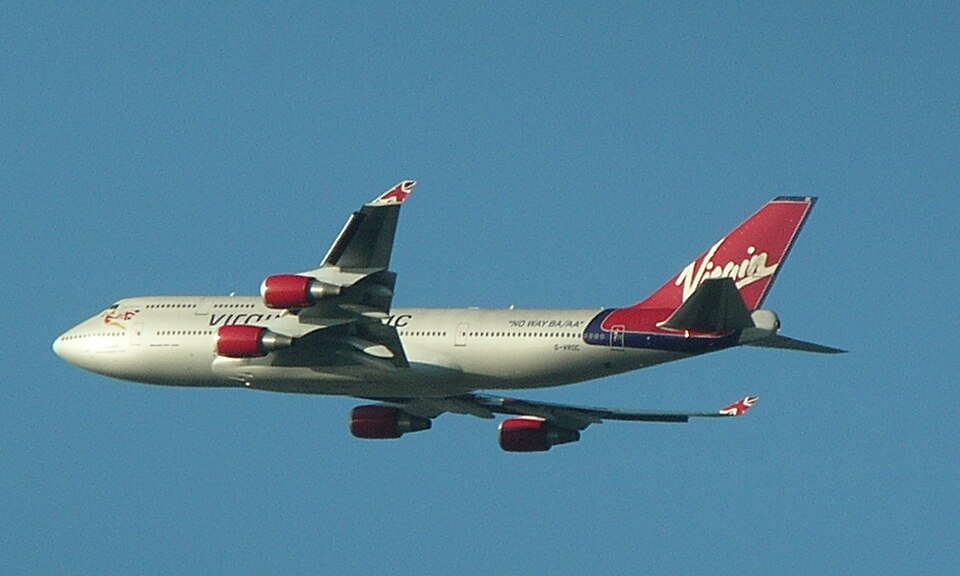
On 28 October 2009, a Boeing 747-41R, registration G-VROC, operated a scheduled passenger service from Johannesburg International Airport (JNB) to London Heathrow Airport. The aircraft had four General Electric CF6-80C2B1F turbofan engines and was manufactured in 2003. The cockpit crew consisted of the commander, the co-pilot (pilot flying), and a third pilot. There were 18 crew and 228 passengers on board; no injuries were reported. The takeoff weight was approximately 351,000 kg.
During the takeoff roll on Runway 03L, shortly after passing V1 (149 kt), the flight crew heard a “large thud”. This was followed by moderate lateral vibrations and vibrations felt through the control column and rudder pedals. The commander called “rotate”, the co-pilot pitched the aircraft nose-up, and after a positive rate of climb was established, the landing gear was selected up and retracted normally. All unusual airframe vibrations ceased after gear retraction.
The pilots discussed the event, initially suspecting a nosewheel strike on a runway centreline light, but the vibration amplitude was greater than usual. They considered a tyre burst. The co-pilot inspected the EICAS gear page, which showed no abnormal indications; tyre pressures were not monitored. The aircraft flew “very well” with no abnormal vibrations or buffeting. Flaps were retracted normally, autopilot engaged, and the departure continued without incident.
The commander contacted JNB Tower to advise of a possible tyre failure and requested a runway inspection. Later, ATC reported finding rubber debris, honeycomb material, and a metal part. Cabin crew reported feeling the thud and vibrations, with one noting the noise from the left side. The third pilot consulted a company pilot travelling as a passenger, who had felt the thud but noticed no abnormalities after gear retraction.
During the flight, the crew contacted the operator’s engineering support (Maintrol), who advised no undue concern absent buffeting or abnormal tyre pressure. The aircraft was not equipped with tyre pressure sensors. The co-pilot broadcast to other aircraft that had departed JNB, but none reported abnormalities.
After reviewing the Flight Crew Training Manual, the pilots decided to continue to London. Maintrol advised London Heathrow of a possible landing gear problem. The commander assumed pilot flying duties, and the crew planned a landing with low autobrake, reverse thrust, and early gear extension. The landing was normal, but the aircraft leaned slightly right after landing. The co-pilot requested a gear inspection from the aerodrome fire and rescue service, which revealed damage to the outboard front tyre on the right wing landing gear (WLG). The aircraft was towed to a stand.
Aircraft Examination
Examination showed the No. 14 tyre (outboard front wheel on the right WLG) had burst, with a large chunk of carcass missing (almost half the circumference). Part of the right WLG shock strut inboard door had separated and was found near Heathrow’s Runway 27R. There was impact damage to the right wing inboard flap fairing and the leading edge and underside of the right inboard aft flap. A wishbone-shaped support bracket (p/n 65B13644-6) connecting the shock strut to the outboard door had failed at its lower forward lug, and a rod (p/n 65B12747-1) connected to the forward door hinge had also failed. Clamps on the shock strut and drag strut of the right WLG were damaged.
Parts Recovered from Johannesburg
A runway inspection at JNB found two large tyre sections (approx. 0.8 m and 0.3 m long), smaller tyre fragments, pieces of aluminium honeycomb, and a metal part. The metal part was identified as part of a failed lug from the wishbone-shaped support bracket. The honeycomb was probably from the WLG shock strut inboard door. When the tyre was reconstructed, a section approximately 0.7 m long was still missing. A further inspection on 10 January 2010 found no additional parts.
Flight Recorder Data
The aircraft was equipped with a 25-hour Flight Data Recorder (FDR), a 120-minute Cockpit Voice Recorder (CVR), and a Quick Access Recorder (QAR). The CVR recording of the takeoff was overwritten. FDR and QAR data were successfully replayed. During takeoff, as the aircraft accelerated through 160 kt (177 kt groundspeed), rapid fluctuations in lateral, longitudinal, and normal acceleration occurred. For one-eighth of a second, normal acceleration changed from 1 g to -2.9 g, coincident with a 0.3 g deceleration and 0.75 g lateral acceleration. This was believed to be from tyre debris or a shockwave striking the accelerometer. Longitudinal acceleration then returned to normal, but the aircraft then exhibited a lateral acceleration oscillation of increasing frequency and reducing amplitude until gear retraction. After gear retraction, acceleration values returned to normal.
The operator also checked Flight Data Monitoring records for G-VROC for airspeed exceedences and hard landings during the tyre’s fitment; none were found.