History of Flight
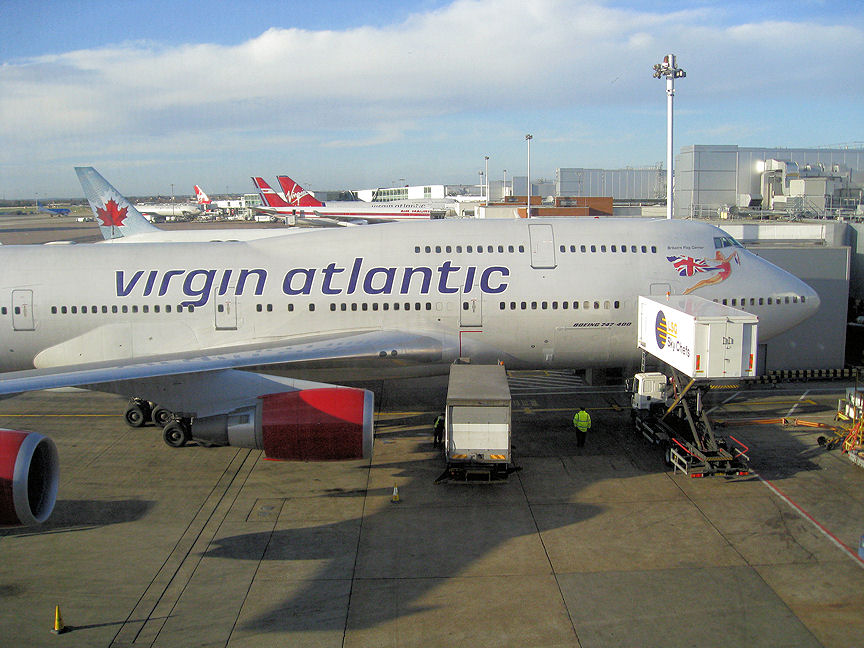
The aircraft, a Boeing 747-41R registered G-VWOW, was operating a scheduled passenger flight from New York's John F Kennedy Airport to London Heathrow Airport (LHR). On 3 November 2005 at 0714 UTC, it landed on Runway 27R at LHR. The approach was conducted in crosswind conditions with a component of approximately 30 kt from the left. The handling pilot, the commander, reported that the touchdown appeared normal. After touchdown, a left roll occurred that was not detected by the handling pilot, who was focused on selecting reverse thrust. This roll resulted in the left-hand (No 1) engine nacelle striking the ground.
Meteorological Conditions
Prior to departure, the crew studied weather forecasts indicating strong southerly winds and a high probability of heavy rain showers at LHR. During cruise, they updated the forecast via ACARS. The ATIS advised Runway 27L as the nominated landing runway, surface wind 200°/12 kt, with windshear and severe turbulence expected. However, due to Tactically Enhanced Arrival Measures (TEAM), the landing runway was changed to Runway 27R. An aftercast from the Meteorological Office described a fresh to strong unstable south-westerly flow. Six minutes after the incident, surface wind was measured as 210° at 23 kt gusting to 36 kt. During the final approach, the first officer noted a rapid reduction in crosswind component, from 32 kt at 24 ft to 8 kt at touchdown.
Aircraft Examination
Examination revealed scraping on the underside of the No 1 engine nacelle, including the inlet cowl, fan cowl doors, C-Duct cowl, and drain mast. The sump and associated pipelines had local deformation. The engine itself was undamaged with no fluid release. Runway inspections found no marks. With the aircraft lightly loaded, ground clearance of the outboard nacelles averaged 75 inches. According to the 747-400 Flight Crew Training Manual, nacelle ground contact could occur with specific combinations of pitch and roll angles, though variation due to wing bending was noted.
Flight Data Recording
Data from the FDR and QAR indicated that up to 6 seconds before touchdown, wind direction was about 200° with speeds varying 15-30 kt. Right rudder was applied about 6 seconds before touchdown. The windspeed reduced to about 8 kt just before touchdown. The aircraft touched down with about 2° left bank at 147 kt. After touchdown, a rocking motion in roll occurred, with bank angle generally 2° left and amplitude ±2°. About 5 seconds after touchdown, bank angle reached 5.6° left, coinciding with reverse thrust selection. The control wheel was then neutralized, bank angle returned to zero, and thereafter into-wind control wheel was applied.
Crosswind Landing Technique
The Boeing 747-400 Flight Crew Training Manual describes crosswind landing techniques, including 'de-crab during flare', which was taught on the operator's conversion and command courses. The manual states the objective is to maintain wings level throughout the approach. After touchdown, speedbrakes deploy to reduce lift and improve braking.
Air Traffic Control
LHR operates alternating landing runways. On the morning of the incident, Runway 27R was in use under TEAM operations. The UK AIP warns pilots of building-induced turbulence and large windshear effects when landing on Runway 27R in strong southerly/south westerly winds.