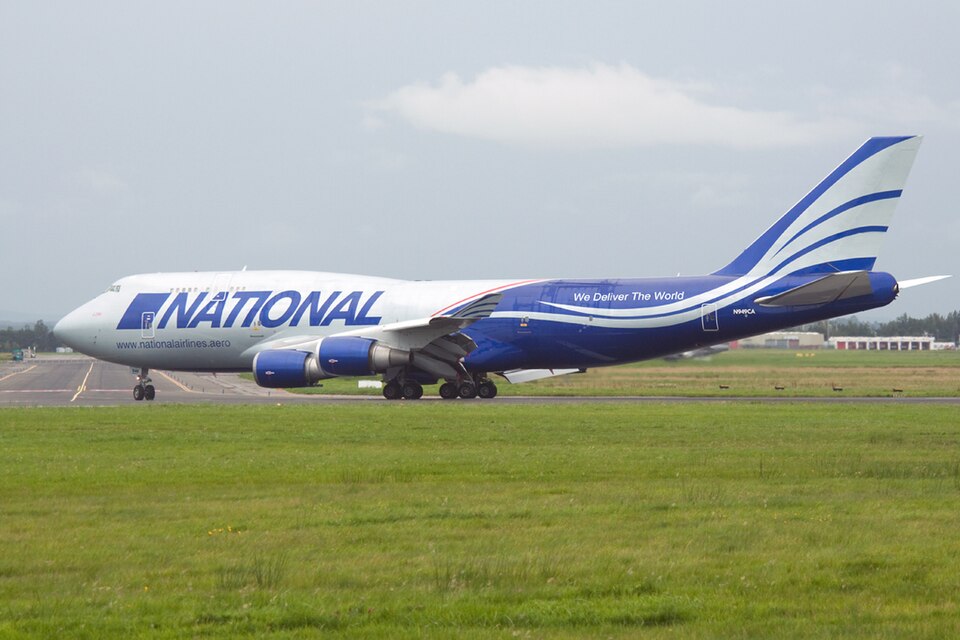
Accident Overview
On the day of the accident, a National Airlines cargo flight operating under 14 CFR Part 121 as a supplemental cargo flight crashed shortly after takeoff from Bagram Air Base, Bagram, Afghanistan. The flight was destined for Dubai World Central - Al Maktoum International Airport, Dubai, United Arab Emirates, under a multimodal contract with the US Transportation Command. All seven crew members—the captain, first officer, loadmaster, augmented captain and first officer, and two mechanics—died, and the airplane was destroyed by impact forces and postcrash fire.
Cargo and Restraint Issues
The airplane's cargo included five mine-resistant ambush-protected (MRAP) vehicles secured onto pallets and shoring: two 12-ton MRAP all-terrain vehicles (M-ATVs) and three 18-ton Cougars. This was the first time National Airlines attempted to transport five MRAP vehicles. Because these vehicles could not be placed in unit load devices (ULDs), they were secured to centerline-loaded floating pallets and restrained to the airplane's main deck using tie-down straps. The vehicles were considered a special cargo load.
During takeoff, the airplane immediately climbed steeply then descended in a manner consistent with an aerodynamic stall. The NTSB investigation found strong evidence that at least one of the MRAP vehicles (the rear M-ATV) moved aft into the tail section, damaging hydraulic systems and horizontal stabilizer components such that it was impossible for the flight crew to regain pitch control. The likely reason for the aft movement was that the cargo was not properly restrained.
National Airlines' procedures in its cargo operations manual omitted required, safety-critical restraint information from the airplane manufacturer (Boeing) and the manufacturer of the main deck cargo handling system (Telair, which held a supplemental type certificate for the system). The procedures also contained incorrect and unsafe methods for restraining cargo that cannot be contained in ULDs. They did not correctly specify which components in the cargo system (such as available seat tracks) were available for use as tie-down attach points, did not define individual tie-down allowable loads, and did not describe the effect of measured strap angle on the capability of the attach fittings.
Investigation Findings and Probable Cause
The National Transportation Safety Board (NTSB) determined that the probable cause of the accident was National Airlines' inadequate procedures for restraining special cargo loads, which resulted in the loadmaster's improper restraint of the cargo. The cargo moved aft and damaged hydraulic systems No. 1 and 2 and horizontal stabilizer drive mechanism components, rendering the airplane uncontrollable. Contributing to the accident was the FAA's inadequate oversight of National Airlines' handling of special cargo loads.