History of the Flight
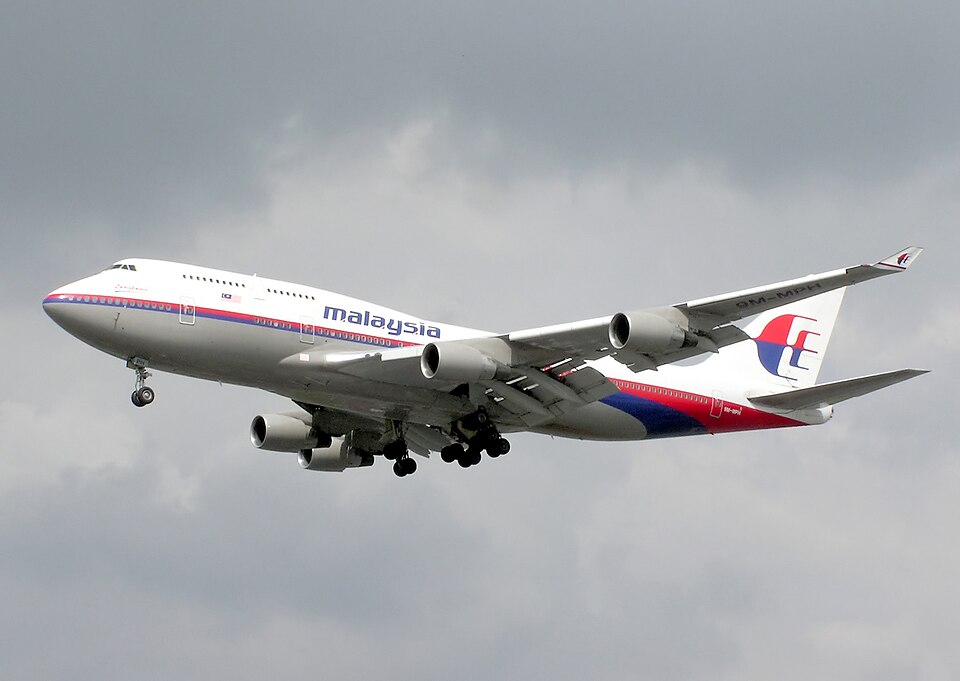
A Boeing 747-4H6, registered 9M-MPH, was scheduled to land at London Heathrow Airport (LHR) on 15 January 2001 at 0530 hrs UTC from a long-haul flight. The aircraft had been allocated parking Stand J2 at Terminal 3. Prior to arrival, a driver from the airline's handling agent positioned three tugs and several baggage dollies side by side to the right of Stand J2, at right angles to the stand centreline. The driver used two white lines painted on the ramp parallel to the stand centreline to judge a safe distance. After positioning the equipment, the driver left to await the aircraft in a supervisor's van parked elsewhere on the stand.
The ramp supervisor responsible for parking the aircraft arrived before the aircraft and conducted a safety check. He noted the tugs and dollies to the right and a 'high loader' vehicle to the left rear of the stand within the stand boundary; none were manned. Although he saw no stand markings to assess safe clearance, he judged the tugs and dollies to be far enough from the centreline to be clear, but was concerned about the 'high loader'. He requested its removal and switched on the Automatic Positioning and Information System (APIS).
As the aircraft turned into the stand, the supervisor monitored the left wingtip clearance with the 'high loader' and began walking toward the jetty. He then noticed an engineer running to the APIS controls to operate the emergency stop button.
The aircraft commander observed that the APIS was lit and saw the tugs and dollies parked on the right. He judged sufficient clearance and continued following the APIS guidance. During the approach to the final parking position, the commander felt a 'bump' and stopped the aircraft. The No.4 engine had collided with one of the tugs, pushing it into others, causing the first tug to tip onto its side and wedge between the ground and the engine nacelle. Damage occurred to the No.4 engine nose cowl, fan cowl, and right reverser sleeve.
A ground engineer present on the stand, responsible for chocking and ground power, was standing near the centreline as the aircraft turned. He became aware of the proximity of the tugs to the No.4 engine and ran to activate the emergency stop button, but was too late.
Stand Information
Stand J2 is located on a Multiple Choice Apron on Pier 6 at LHR Terminal 3. To the left is a terminal building connecting Piers 5, 6, and 7; to the right are parking Stands J4 to J10. Stands J2 and J6 are parallel and can each accommodate a single Boeing 747-2/300 sized aircraft. When J2 or J6 is used for 747 parking, J4 may not be used; if neither is used for 747 parking, J2, J4, and J6 may be used for smaller aircraft.
Stand Markings
General guidance on surface markings is provided in CAP 637. Pilot-use markings are yellow; service vehicle markings are other colours. The multi-choice apron at Stand J2 has parallel white bars between some stands, similar to MARS bars, indicating the maximum wingspan of MD 80 series aircraft. Between these bars, 'NO PARKING' was written in faint white paint. The AIP provides limited information on markings, while OSI 52/97 describes three stand types: single centreline, MARS, and multi-choice apron. J2 is a multi-choice apron stand.
Parking Procedures
OSI 23/99 outlines procedures for stands with Stand Entry Guidance Systems (SEG). A pre-arrival safety check must ensure the stand is unobstructed. After the check, the SEG is switched on to indicate to flight crew that the stand is clear. Emergency stop procedures involve a button at ramp level that cuts power to the SEG and activates a 'STOP' sign. Staff are required to remain vigilant but not necessarily within rapid response range of the button.
Vehicle Control
OSI 24/00 prohibits parking on empty aircraft stands and within interstand clearways. Aircraft stands must be kept clear and free from obstructions at all times.
Airport Congestion
A shortage of parking space at Heathrow, being addressed by Terminal 5 proposals, leads to use of MARS and multi-choice aprons, which reduce space for service vehicle parking. The increase in handling agents and vehicles has exacerbated this issue, and agents are investigating equipment sharing.
Additional Information
The airport operator sets policy via Operational Safety Instructions (OSIs). Monitoring is conducted by Apron Safety Units, but they have other responsibilities. The investigation attempted to quantify ground damage occurrences at LHR.