Background
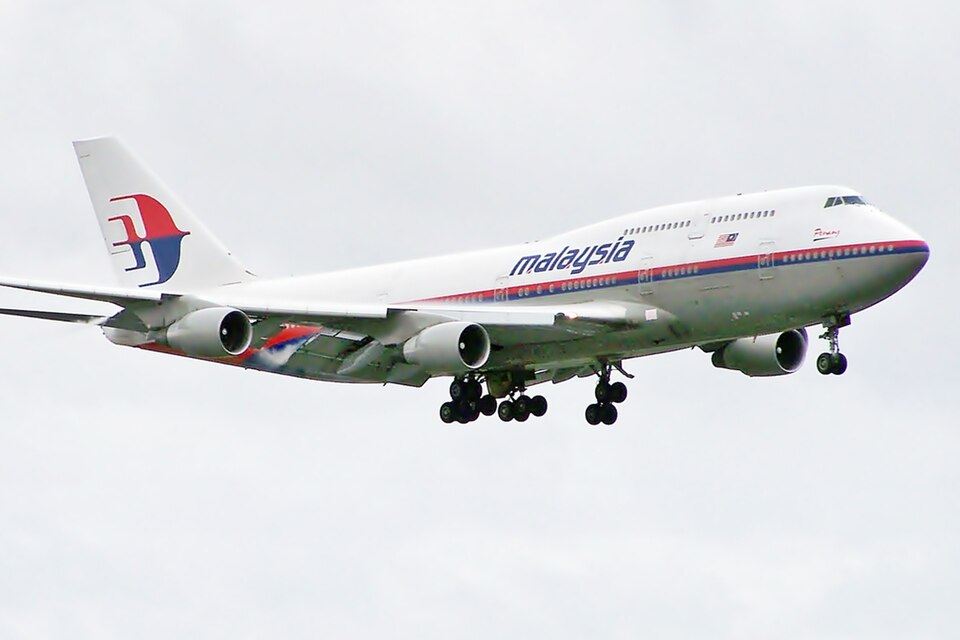
On 17 August 2012, a Boeing 747-4H6, registration 9M-MPL, operated a commercial passenger flight from London Heathrow Airport to Kuala Lumpur International Airport. The aircraft carried 4 flight crew, 18 cabin crew, and 340 passengers. Takeoff occurred at 2129 hrs UTC.
Engine Failure
During climb through FL150, the crew felt vibrations. The No 2 engine vibration indicator read 2.3 units, higher than the 0.9 units on other engines. The commander disconnected and re-engaged the autopilot. As the aircraft passed FL170, vibrations increased and fuel flow on No 2 engine fluctuated at around 0.3 tonnes per hour compared to 5 tonnes per hour on other engines. Reducing thrust to idle lowered vibration but oil pressure exceeded limits. A bang was heard, and the engine fail EICAS message appeared. The crew shut down the engine following the appropriate checklist and leveled at FL190. They requested ATC clearance to return to Heathrow and proceeded to a holding point over the North Sea to jettison fuel.
Fuel Jettison and Approach
Between 2201 and 2243 hrs, the crew jettisoned approximately 75,000 kg of fuel, reducing gross weight to about 285,000 kg. The aircraft then began an approach to Runway 09R. The crew briefed for an autoland due to night conditions, heavy weight, and the inoperative engine. The left autopilot was initially in command, and later all three autopilots were engaged. At 2301:56 hrs, while level at about 3,000 ft amsl, AC Bus 2 experienced a momentary power loss. Within seconds, a master warning triggered, all autopilots disengaged, and cockpit displays and lights began flickering. The commander took manual control. Autothrust disengaged shortly after. The displays continued flickering until touchdown; standby instruments remained unaffected.
Landing and Aftermath
During the landing, the radio altimeter failed to provide the standard 100 ft callout; only a 20 ft call was heard. The commander flared between 34 ft and 12 ft agl. Touchdown occurred at 155 kt with a 1.5° right wing down attitude and a drift angle of 2.4°. Peak normal acceleration reached 1.41g, and lateral acceleration 0.167g. Rate of descent was between 6 and 8 ft/sec. The landing was described as hard. After rollout, the aircraft taxied to stand. No injuries were reported. Examination revealed metallic debris in the No 2 engine and damage to the keel beam. The CMC recorded multiple electrical system faults.
Investigation
The AAIB investigation determined that the flickering displays and lights resulted from a series of electrical system failures, primarily caused by a latent mechanical failure in a Bus Tie Breaker. This failure became apparent when the electrical system reconfigured for the planned autoland. One Safety Recommendation was issued. The probable cause of the electrical anomalies was a latent mechanical failure in a Bus Tie Breaker.