History of the Flight
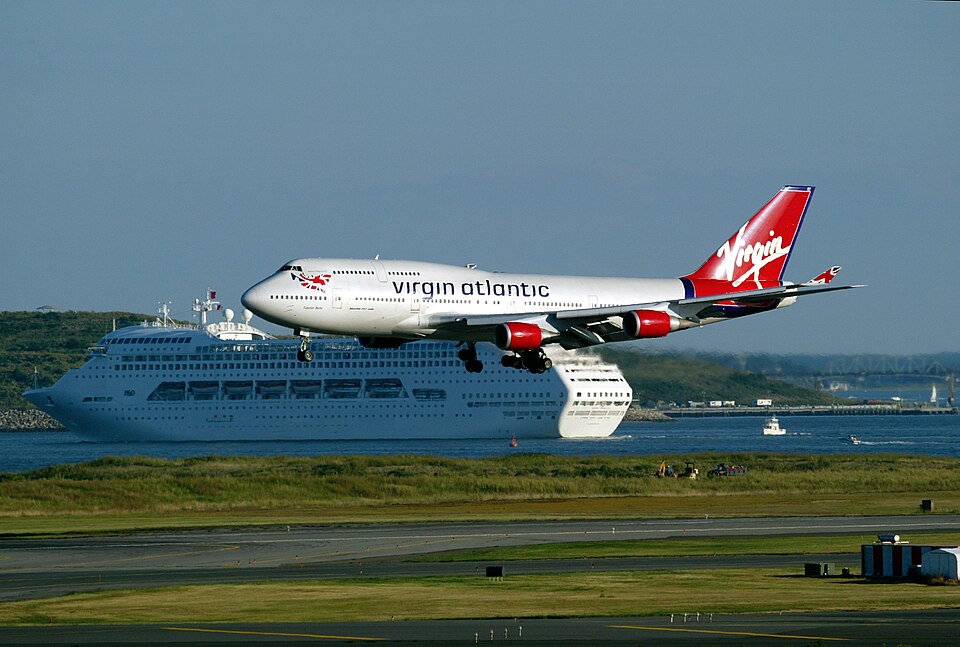
On 7 December 2006, at 1445 UTC, a Boeing 747-4Q8 (registration G-VHOT) was preparing for a commercial passenger flight from London Heathrow Airport to New York. The aircraft had 386 passengers, 2 flight crew, and 18 cabin crew on board. The takeoff mass was 325,623 kg, with 88,200 kg of fuel. The crew calculated takeoff speeds: V1 146 kt, VR 156 kt, V2 165 kt. The co-pilot was designated as pilot flying.
The surface wind was from 240° at 21 kt gusting to 31 kt, visibility greater than 10 km, with scattered cloud at 3,400 ft and 4,500 ft. Temperature was 11°C, dewpoint 6°C, QNH 986 mb.
First Takeoff and In-Flight Troubleshooting
After lining up on Runway 27R and receiving takeoff clearance, the commander advanced the thrust levers. At 80 kt, the crew cross-checked airspeed indications, which agreed. Shortly before V1, both stick shakers began operating continuously. The commander described this as “extremely distracting” but elected to continue the takeoff, suspecting the warning was spurious. During the initial climb, he verified that speed, attitude, and thrust were correct.
The co-pilot continued flying and engaged the autopilot. The commander sought the stick shaker circuit breakers but initially could not locate them. He contacted company operations and then engineers by radio, who described the breakers' location. He pulled both breakers, stopping the shakers.
An 'alt disagree' message appeared on the Engine Indication and Crew Alerting System (EICAS), showing the co-pilot's altitude as FL170 and the commander's as FL167, with the standby altimeter indicating FL166 or 167. Subsequently, an 'ias disagree' message appeared. The crew cross-checked altitude and airspeed indications for the remainder of the flight.
The crew decided to return to Heathrow, notified Air Traffic Control (ATC), and dumped fuel. The London Terminal Control Centre provided a dedicated ATC service, clearing traffic and stopping movements at London City Airport to ensure sterile airspace for the arrival. The aircraft landed without incident at 1556 hrs.
Maintenance Actions
After landing, maintenance engineers consulted the aircraft's Built-In Test Equipment (BITE) and replaced the right-hand Air Data Computer (ADC). Following this, the operator's crewing staff discussed duty times with both pilots. No standby crew were available, and both pilots agreed to extend duty using commander's discretion. The aircraft was refueled (89,300 kg, takeoff mass 327,423 kg) and provided with paperwork for a further departure.
Second Takeoff Attempt
The second takeoff on Runway 27R commenced at 1744 hrs, with the co-pilot handling. The new takeoff speeds were V1 147 kt, VR 157 kt, V2 165 kt. The departure ATIS reported wind from 240° at 21 kt, visibility greater than 10 km, towering cumulus at 3,500 ft, temperature 9°C, dewpoint 4°C, QNH 988 mb, and windshear forecast.
Approximately 5 kt before V1, the stick shakers again began to operate. The commander immediately rejected the takeoff, and the crew performed the appropriate drills. The aircraft stopped safely about two-thirds of the way along the runway. The crew then taxied to a parking position, monitoring brake temperatures. The passengers were accommodated overnight, and the crew went off duty.
Conclusion
No damage or injuries were reported. The incident was investigated by the AAIB, which noted safety actions implemented by the operator and aircraft manufacturer. Recorded data from the Flight Data Recorder and Quick Access Recorder showed no anomalies in angle of attack parameters or ADC faults; a landing gear status anomaly was attributed to recording/sensing error.