Accident Overview
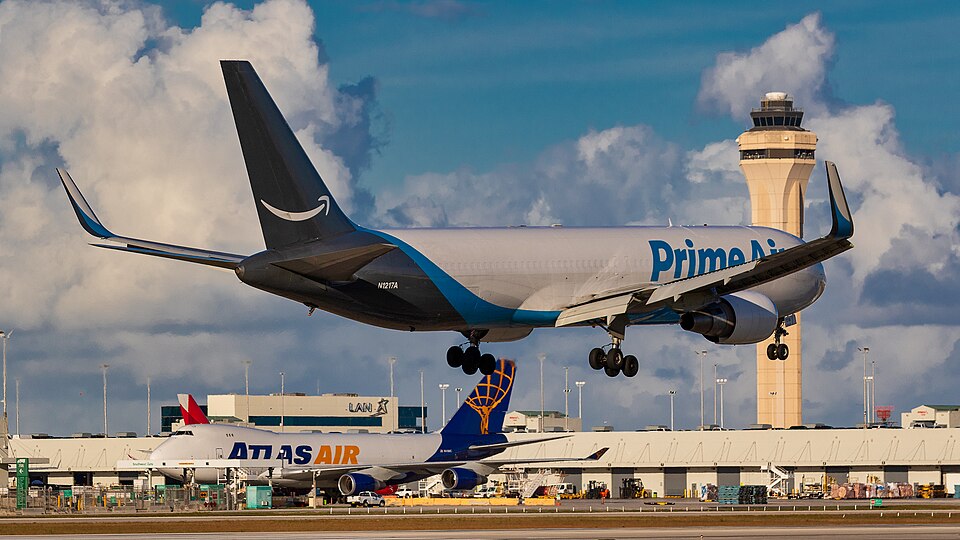
On February 23, 2019, at 1239 central standard time, Atlas Air Inc. flight 3591, a Boeing 767-375BCF (registration N1217A), was destroyed when it crashed into a shallow, muddy marsh area of Trinity Bay, Texas. The accident site was about 41 miles east-southeast of George Bush Intercontinental/Houston Airport (IAH), Houston, Texas. The captain, first officer, and a nonrevenue pilot riding in the jumpseat died. The flight was operated as a Title 14 Code of Federal Regulations Part 121 domestic cargo flight for Amazon.com Services LLC, with an instrument flight rules flight plan.
Flight Sequence
The flight departed from Miami International Airport (MIA), Miami, Florida, at about 1033 (1133 eastern standard time) and was destined for IAH. The departure, en route cruise, and initial descent toward IAH were uneventful. As the flight descended, the crew extended the speedbrakes, lowered the slats, and began setting up the flight management computer for the approach. The first officer was the pilot flying, the captain was the pilot monitoring, and the autopilot and autothrottle were engaged and remained engaged for the remainder of the flight.
Weather and Go-Around Activation
About 1238:25, the airplane began penetrating the leading edge of a cold front, where windshear and instrument meteorological conditions were likely. At 1238:31, go-around mode was activated while the airplane was about 40 miles from IAH and descending through about 6,300 ft msl toward 3,000 ft msl. Neither pilot made a go-around callout. Within seconds of go-around mode activation, manual elevator control inputs overrode the autopilot, forcing the airplane into a steep dive. 32 seconds elapsed between go-around activation and ground impact.
Probable Cause
The National Transportation Safety Board determined that the probable cause of this accident was the inappropriate response by the first officer as the pilot flying to an inadvertent activation of the go-around mode, which led to his spatial disorientation and nose-down control inputs that placed the airplane in a steep descent from which the crew did not recover. Contributing to the accident was the captain’s failure to adequately monitor the airplane’s flightpath and assume positive control of the airplane to effectively intervene. Also contributing were systemic deficiencies in the aviation industry’s selection and performance measurement practices, which failed to address the first officer’s aptitude-related deficiencies and maladaptive stress response. Also contributing to the accident was the Federal Aviation Administration’s failure to implement the pilot records database in a sufficiently robust and timely manner.