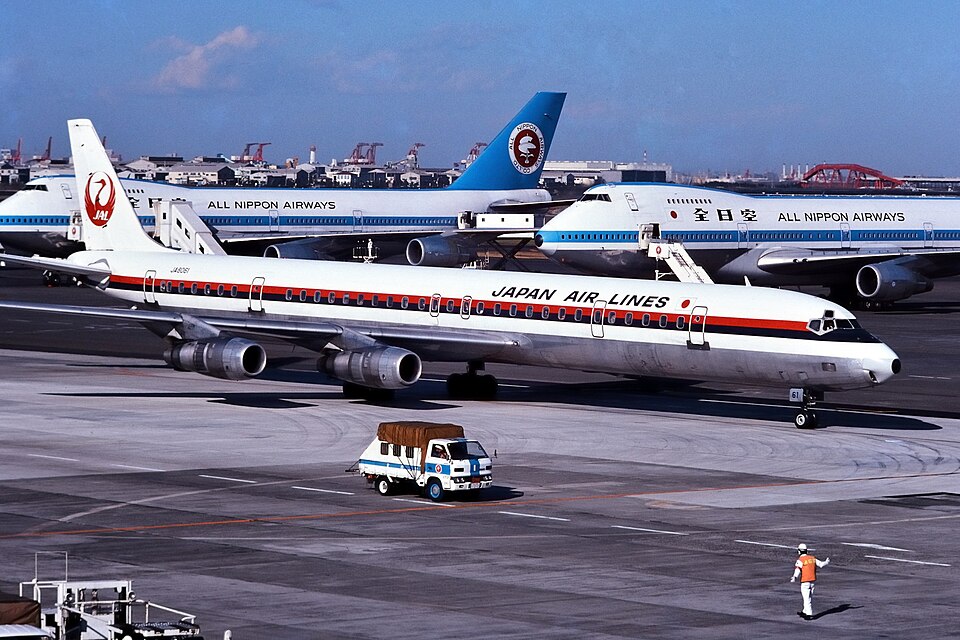
Flight Details
Japan Air Lines (JAL) Flight 350 departed Fukuoka Airport (FUK) runway 16 at 07:34, bound for Tokyo-Haneda (HND). The aircraft climbed to cruising altitude FL290. At 08:22, the crew began descent to FL160. After reaching that altitude, they received clearance to descend to 3,000 feet. The approach was for runway 33R using an Instrument Landing System (ILS).
Cockpit Activity
At 08:35, flaps were set to 5°, then to 25° one minute later. The landing gear was lowered at 08:39, and flaps were extended to 50° two minutes after that. At 08:42, the aircraft passed through 1,000 feet at an indicated airspeed of 135 knots, with wind from 360° at 20 knots. At 08:43:25, the co-pilot called out "500 feet," but the captain did not make the "stabilized" call-out required by JAL operational regulations. The airspeed decreased to 133 knots while descending through 300 feet at 08:43:50, and the co-pilot warned the captain that the aircraft was approaching the decision height.
Accident Sequence
At 08:43:56, the radio altimeter warning sounded. Three seconds later, the flight engineer called out "200 feet," which was the decision height. At 08:44:01, the aircraft descended through 164 feet at 130 knots indicated airspeed. At that moment, the captain disconnected the autopilot, pushed his controls forward, and retarded the throttles to idle. The co-pilot attempted to regain control, but the aircraft struck the shallow water of Tokyo Bay, 510 meters short of the runway 33R threshold. The nose and right wing separated from the fuselage.
Probable Cause
The official probable cause was a collision with approach lights during an unstabilized approach, attributed to poor crew coordination and wrong approach configuration on the part of the captain. The captain had recently suffered from a psychosomatic disorder and had been off duty from November 1980 to November 1981. Preliminary reports suggested he experienced a mental aberration at the time of the accident.