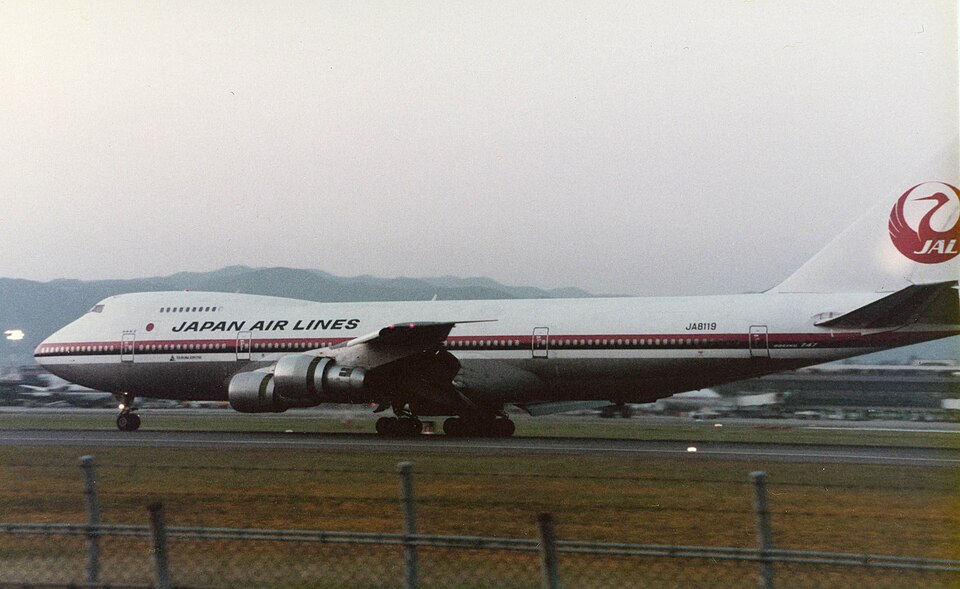
Background
Japan Air Lines operated Boeing 747SR JA8119, a short-range variant of the 747-100 configured for high-density domestic flights. On June 2, 1978, the aircraft experienced a tail strike during landing at Osaka (ITM) after floating on touchdown. The rear underside of the fuselage and the rear pressure bulkhead sustained substantial damage, including cracks. Boeing performed repairs, replacing the lower part of the rear fuselage and a portion of the lower half of the bulkhead.
Final Flight
On August 12, 1985, JA8119 completed four domestic flights before landing at Tokyo-Haneda (HND) at 17:17. The next leg was to be Flight 123 to Osaka (ITM). The aircraft took off at 18:12. Twelve minutes later, while climbing through 23,900 feet at 300 knots, an unusual vibration occurred. An impact force raised the aircraft's nose and control problems were experienced. A decompression happened and the crew received indications of a problem with the R5 door. In fact, the rear pressure bulkhead had ruptured, causing serious damage to the rear of the plane. A portion of the vertical fin (5 meters) and the tail cone containing the auxiliary power unit were torn off.
Due to the damage, hydraulic pressure dropped, rendering ailerons, elevators, and the yaw damper inoperative. The aircraft began experiencing Dutch rolls and phugoid oscillations—unusual movements with significant changes in altitude and speed over 20–100 second cycles without change in angle of attack. The crew attempted to control the aircraft using engine thrust. The aircraft descended to 6,600 feet, where airspeed dropped to 108 knots. It then climbed with a 39-degree pitch-up to approximately 13,400 feet before descending again.
Crash
At 18:56, JA8119 brushed against a tree-covered ridge, continued, and struck the Osutaka Ridge, bursting into flames. A stewardess, one female passenger, and two little girls survived; 520 other occupants were killed.
Probable Cause
It is estimated that this accident was caused by deterioration of flying quality and loss of primary flight control functions due to rupture of the aft pressure bulkhead of the aircraft, and the subsequent ruptures of a part of the fuselage tail, vertical fin and hydraulic flight control systems. The reason why the aft pressure bulkhead was ruptured in flight is estimated to be that the strength of the said bulkhead was reduced due to fatigue cracks propagating at the spliced portion of the bulkhead's webs to the extent that it became unable to endure the cabin pressure in flight at that time. The initiation and propagation of the fatigue cracks are attributable to the improper repairs of the said bulkhead conducted in 1978, and it is estimated that the fatigue cracks having not be found in the later maintenance inspection is contributive to their propagation leading to the rupture of the said bulkhead.