Accident Details
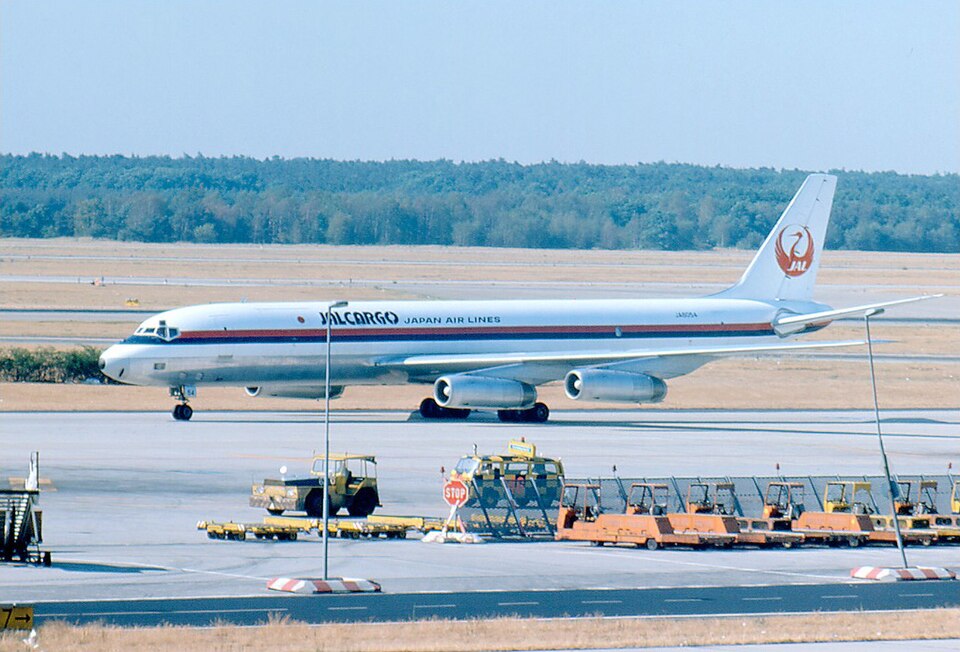
On January 13, 1977, a Japan Air Lines (JAL) McDonnell-Douglas DC-8-62F, registration JA 8054, operated as an international charter cargo flight from Moses Lake, Washington, to Tokyo, Japan, with an en route stop at Anchorage, Alaska. The aircraft arrived at Anchorage at 0503. The incoming crew reported encountering only fog on approach at 800 feet, with no precipitation or icing.
Pre-flight Events
The aircraft was serviced and a walk-around inspection was performed by JAL maintenance and contract mechanics. Two contract mechanics stated there was ice on the inlet guide vanes, engine cowlings, and engine bullet noses, but no ice on the airfoil surfaces. JAL personnel reported seeing no ice. One contract mechanic advised using the engine anti-icing system to clear the ice.
The outbound crew awoke about 0330, left the hotel by taxi around 0430, and arrived at JAL dispatch about 0500. The taxi driver reported concerns about the captain's condition: uncoordinated movements, flushed face, glazed eyes, garbled conversation, and trouble exiting the cab. The driver called his dispatcher, who then contacted an operations agent. The operations agent noted that he felt JAL would detect anything unusual. JAL dispatch and the inbound crew observed nothing unusual about the outbound crew, and the dispatch briefing proceeded smoothly.
The outbound crew consisted of an American captain and a Japanese first officer and flight engineer. A crew car driver, a friend of the captain, stated he appeared in good condition.
Flight Preparation and Takeoff
A cockpit voice recorder (CVR) review indicated that about 0603, the captain and first officer checked inertial navigation system inputs and ATIS (visibility 1/4 mile, fog). Checklists were completed, and the stickshaker was tested. Engines were started about 0615. During taxi, the flight engineer requested and received permission to turn on the engine anti-ice system due to ice on inlet guide vanes. The de-ice system was reported off. The captain briefed on takeoff and abort procedures, noting the slippery runway.
The captain taxied toward runway 24L but initially stopped on the ramp after being instructed to hold short of runway 24R. After communications with the tower, he mistakenly positioned on runway 24R, then made a 180° turn and taxied to runway 24L. The crew reported ready for takeoff at 0633:37.
Takeoff began. At 0634:32, the captain called "maximum power." At 0634:50, "I have"; at 0634:52, "80" knots; at 0635:10, "V1"; at 0635:16, rotation; at 0635:19.5, "10 degrees"; at 0635:21.4, V2. At 0635:26.2, a sound similar to aircraft buffet was recorded, becoming more frequent until impact. At 0635:32, "Gear up"; at 0635:33, "Too much speed (steep)"; at 0635:38, "stall" and stickshaker sounded until impact at 0635:39.3.
A witness near the departure end of the runway saw the aircraft climb to about 100 feet, veer left, and then slide out of the air. The aircraft was totally destroyed; all five occupants and the 56 cows on board were killed.
Probable Cause
The official probable cause was a stall resulting from pilot control inputs aggravated by airframe icing while the pilot was under the influence of alcohol. Contributing was the failure of the other flightcrew members to prevent the captain from attempting the flight.