Incident Summary
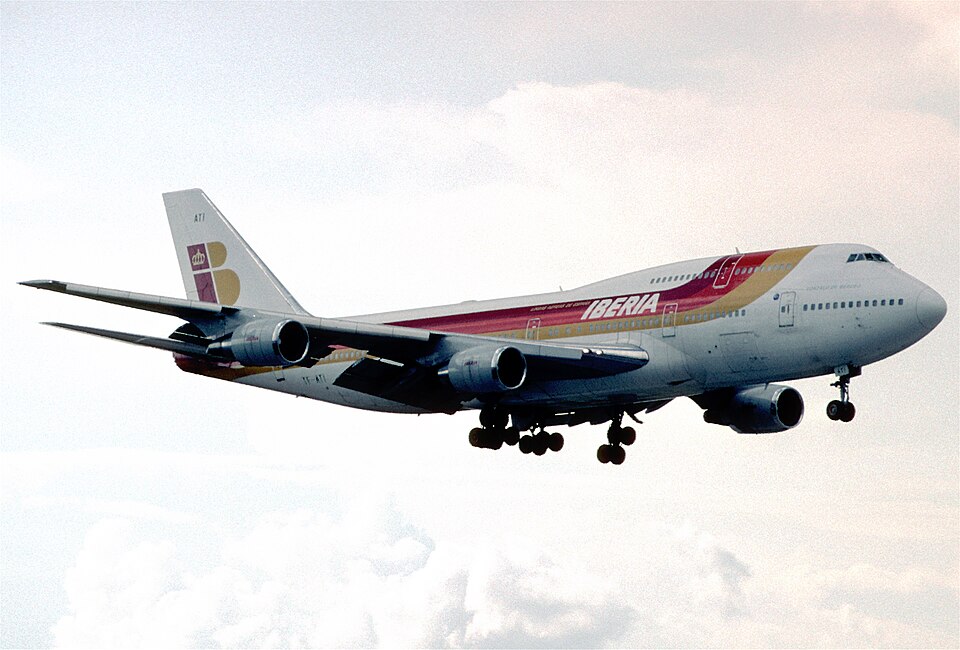
On 23 January 2005 at 13:06 local time, a Boeing 747-300 aircraft registered as TF-ATI, operated by Iberia, was preparing for takeoff from runway 36L at Madrid-Barajas Airport. The flight, IB-6501, was a scheduled international passenger service to Santo Domingo with 318 passengers and 17 crew members aboard. The runway was dry, wind was calm, and visual meteorological conditions prevailed.
During the takeoff run, the crew felt what they initially considered normal vibrations at 35 knots. However, when the copilot called out 80 knots, the vibrations intensified significantly. The instrument panel hood vibrated, and the aircraft began jerking sideways and lurching abnormally. The crew decided to abort the takeoff. During braking, the vibrations became more violent and ceased only when the aircraft came to a complete stop. After stopping, the high brake temperature caused the thermal fuses on the left wing-mounted and fuselage landing gear legs to trip, deflating the tires. An emergency was declared, and the fire brigade escorted the aircraft to its parking area.
Investigation Findings
Laboratory analysis of the Digital Flight Data Recorder (DFDR) showed a 12-second data gap during the abort sequence. The investigation determined that the vibrations were caused by a self-sustained oscillation in the nose gear steering system, stemming from a malfunction in the steering system regulating valve. The valve's function is to direct hydraulic pressure to the steering cylinders and to center the wheel while dampening oscillations. A malfunction here prevented proper damping and led to the oscillation.
During taxi-out, the crew had noted that the body gear warning lights did not illuminate during sharp turns, so they disconnected the body gear steering and locked the fuselage legs for takeoff per abnormal procedures. No other warnings were received.
Aircraft and Crew
The aircraft was a Boeing 747-300 built in 1988, owned by ILFC and operated by Iberia. It had accumulated 66,707 flight hours and 11,549 cycles. The flight crew consisted of a captain aged 58 with 20,877 total flight hours (4,994 on type), a first officer aged 34 with 5,766 hours (1,298 on type), and a flight engineer aged 55 with 15,225 hours (1,313 on type). The aircraft was within weight and balance limits.
Maintenance History
Maintenance records show the last A4 check on 29 December 2004 at 66,597 flight hours, the last C (SP) check on 31 May 2004, and the last C2 check on 16 March 2003. The C2 check included measurement of torsion link freeplay on the nose gear, which was recorded at 0.118 inches against a limit of 0.19 inches. The C (SP) check performed a visual inspection only.