Flight History
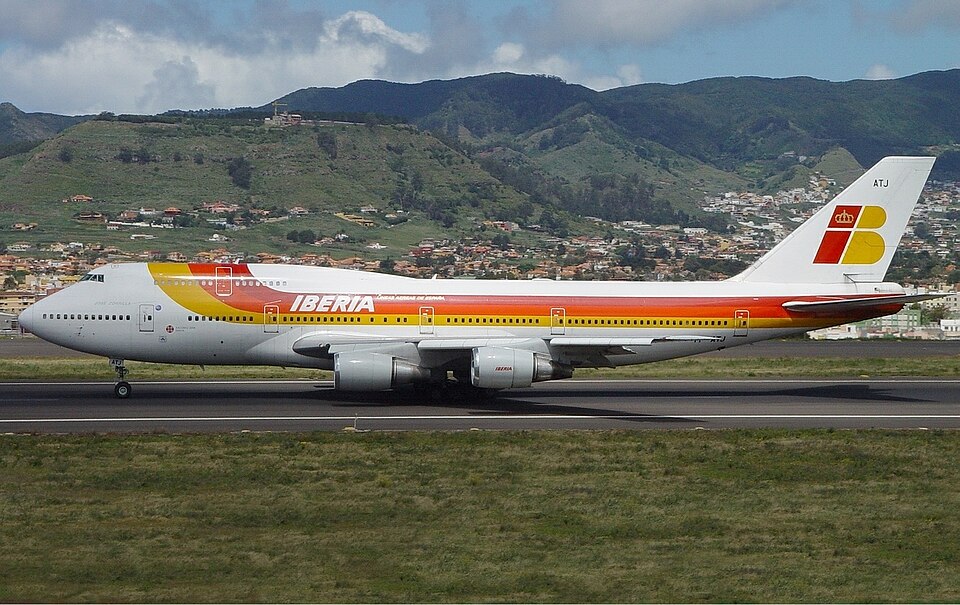
The flight, a scheduled domestic passenger service operated by Air Atlanta Icelandic under a wet lease agreement with Iberia, departed Madrid without incident. The Boeing 747-400 (registration TF-ATJ, serial number 24108) approached Tenerife Norte Airport (TFN) after an uneventful cruise. Prior to descent, the crew briefed the approach, noting minimum sector altitudes and a Vref speed of 142 knots with flaps 30, including a 10-knot wind correction.
Descent from FL330 began at 100 NM from the TFN VOR with ATIS Y (wind 330/22G28, QNH 1021). The crew reported high speed during descent. At 09:53, they requested radar vectors to reduce speed, citing IMC. After being cleared for a straight-in approach, they executed a right heading 270 for final vector. By 09:59, they reported established on the localizer at 13 NM, descending with the glide slope. The approach checklist was completed.
Approach and Landing
Once established on the glide slope, the aircraft descended with autopilot B engaged, flaps 20°, at Vref plus 20 knots. No significant turbulence or speed changes were noted initially. Landing gear was extended at about 6 NM, and flaps 25° then 30° selected. At approximately 1500 ft AGL, visual contact with TFN was established, and communication switched to tower frequency.
As the approach continued, turbulence was noted. The crew disconnected autopilot B and flew manually. Tower cleared landing on runway 30 with reported wind 320/24. The aircraft was on the localizer and glide slope at Vref plus 10 knots. Descending through 1000 ft AGL, a wind shift caused an estimated 15-knot increase in indicated airspeed, which was corrected back to Vref plus 10 knots. At about 10 ft above the runway during the flare, a sudden wind shift produced more lift on the left wing, according to the crew. The pilot flying (first officer) reacted, resulting in a firm landing. The aircraft touched down on the runway centerline.
Post-Flight Inspection and Damage
After landing, the aircraft vacated runway 30 normally and taxied to the gate. Passengers disembarked without incident. Later, ground personnel observed damage to the number 4 engine cowling: two holes at the bottom and several scratch marks with glass slivers. The crew notified ATC at 10:27, prompting a runway inspection. Two runway edge lights on the right side were completely broken, two others had broken glass, and between the two broken lights, deep grooves and scratches (2 to 4 cm wide) were found on the runway surface.
The aircraft underwent inspections, including a hard landing check, and was ferried back to base several days later.
Aircraft and Crew Information
The Boeing 747-400 (length 70.4 m, width 59.6 m) had four CFM CF6-80C2B1 engines. The landing weight was approximately 261,166 kg (maximum 285,752 kg). The crew consisted of a pilot in command (Spanish, 44, ATPL, 9,515 total hours, 529 on type), a first officer (U.S., 49, ATPL, 9,258 total hours, 1,321 on type), and a flight engineer (U.S., 56, flight engineer license). Both pilots had started duty at 05:40 after over 24 hours of rest. The first officer's medical certificate had expired 19 days before the incident.
Cockpit Voice Recorder
The CVR (L-3 Communications, part number 93A100-30) had stopped recording during a previous flight due to tape damage caused by an aged capstan drive wheel. The recorder was not overhauled in accordance with maintenance requirements, leading to loss of recording capability.