Background
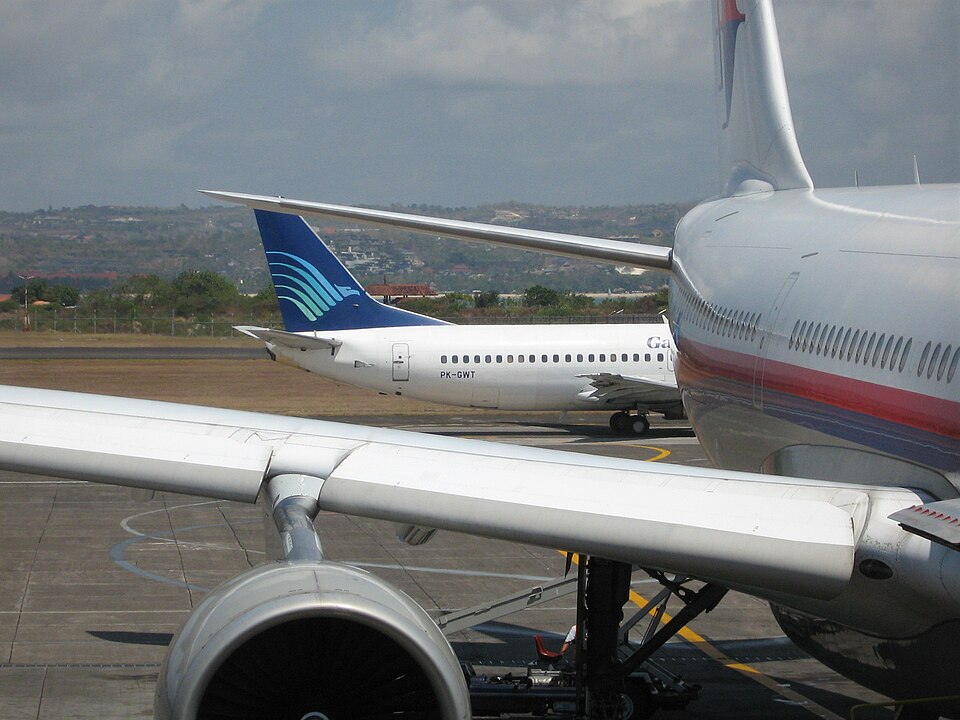
On 2 October 2008, a Boeing Company 737-4K5 aircraft, registered PK-GWT, was operated by PT. Garuda Indonesia on an Instrument Flight Rules scheduled passenger service from Jakarta Soekarno-Hatta Airport to Sultan Mahmud Badaruddin II Airport, Palembang, Republic of Indonesia.
Flight Crew
The co-pilot, occupying the left seat, was a candidate captain under training and was acting as Pilot Flying (PF). The Pilot in Command (PIC), occupying the right seat, was a training captain (instructor) acting as Pilot Monitoring (PM).
Pre-flight Information
Prior to departure from Jakarta, the pilots received a departure briefing including weather, flight plan, and NOTAMs. The NOTAMs contained significant information for Palembang Airport: the parallel taxiway from intersection Alpha to taxiway Bravo was closed due to work in progress, and the runway 29 Instrument Landing System (ILS) was not in service due to replacement of its localizer antenna.
Approach and Landing
When the aircraft entered Palembang’s controlled airspace, the crew was instructed to descend to 2,500 feet for the VOR/DME approach to runway 29. At 00:30, the PIC reported that he had the runway in sight after assuring the co-pilot that they had all seen the runway. The Aerodrome Controller gave the crew clearance to land.
The co-pilot was concentrating on instrument scanning during the approach by following the VOR radial, aiming to improve his ability to fly manual during an instrument approach. The PIC was rechecking whether any items had been missed prior to landing.
Air Traffic Control observed that the aircraft was not on the approach path properly and came close to the parallel taxiway. At 00:32, the aircraft landed on the parallel taxiway.
Investigation Findings
The investigation by the National Transportation Safety Committee (NTSC) found that both pilots were concentrating looking inside and not sufficiently cross-checking to the outside situation. The aircraft continuously descended below Minimum Descent Altitude (MDA) and landed. The pilot monitoring did not sufficiently look outside to cross-check the flight path to the runway. There was misalignment of the VOR approach path. The controller noticed that the aircraft was not aligned with the runway. According to Air Traffic Service procedures, the controller could only issue a landing clearance and was not required to provide further instructions.
Cause
The NTSC determined that the cause of this incident was the continuation of the approach below Minimum Descent Altitude without visual reference to the runway.
Safety Actions and Recommendations
The NTSC issued recommendations to PT. Garuda Indonesia, PT. Angkasa Pura II (airport operator), and the Directorate General of Civil Aviation. Specific recommendations included improvements to crew coordination, visual cross-check procedures, and runway marking visibility.