History of the Flight
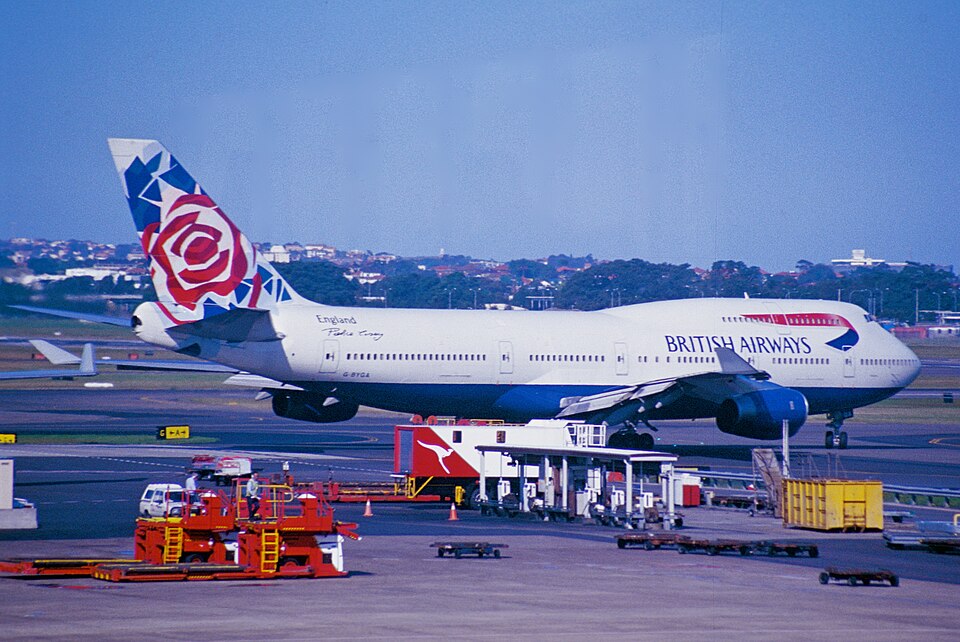
On 11 May 2009 at approximately 1835Z, a Boeing 747-400 aircraft registered G-BYGA departed Runway 03L at O.R. Tambo Airport (FAJS) on a scheduled international passenger flight to Heathrow International Airport (EGLL). The aircraft carried 3 cockpit crew, 15 cabin crew, and 265 passengers. The first officer was the pilot flying (PF) for the departure, and the takeoff was planned at reduced power. Calculated speeds were V1=150kt, VR=168kt, and V2=176kt.
During the takeoff roll, the No. 3 engine thrust reverser EICAS amber message ('REV') displayed on the P2 center instruments panel at approximately 125.6kt (before V1). Shortly after, the No. 2 engine thrust reverser EICAS amber message displayed at approximately 159.9kt (prior to rotation). Consequently, the Group 'A' leading edge (LE) flaps retracted automatically, as designed, while the aircraft was still on the ground.
The aircraft rotated at approximately 173kt with 20 units of flaps selected and became airborne at about 176kt. The stick shaker activated intermittently for 8 seconds within a 15-second period, accompanied by significant buffeting. The PF, who had aerobatic flying experience, continued flying the aircraft while the PIC called out heights above ground level (AGL). The undercarriage was selected up at 177kt CAS, and the Group 'A' LE flaps immediately re-extended automatically. The stick shaker stopped at approximately 186kt. The Group 'A' LE flaps had been retracted for about 23 seconds during the incident. After re-extension, aircraft performance returned to normal.
The flight crew was not aware that the Group 'A' LE flaps had retracted, as the indication on the flap indicator EICAS display is hardly visible and there was no independent warning. While climbing through 7000ft, the crew declared an emergency and later informed ATC of No. 2 and No. 3 engine problems. They subsequently returned to the airport for an uneventful landing approximately two hours later.
Findings
- The thrust reverser in-transit EICAS amber messages were generated by sensors on No. 2 and No. 3 engines. Ground testing revealed that the reversers were not fully stowed against the stops, and one of the four locking gearboxes on each of those engines had unlocked. However, no evidence indicated that the thrust reversers actually deployed.
- The automatic retraction of Group 'A' LE flaps upon dual thrust reverser unlock signals from inboard or outboard engines was part of the original 747-400 type design certified in January 1989. The design was intended to prevent thrust reverser efflux from impinging on flap panels.
- Factors that prevented the situation from becoming an accident included the timely response by the PF, activation of the stick shaker, and the re-extension of the flaps when the air/ground logic switched to air mode.
Probable Cause
The probable cause for this serious incident is attributed to the loss of a significant amount of lift on rotation, during the takeoff, caused by the automatic LE flap retraction logic retracting the Group 'A' LE flaps upon receipt of spurious thrust reverser unlock signals from the No. 2 and No. 3 engines. The possibility of such an occurrence had not been identified during amendment of the retraction logic.