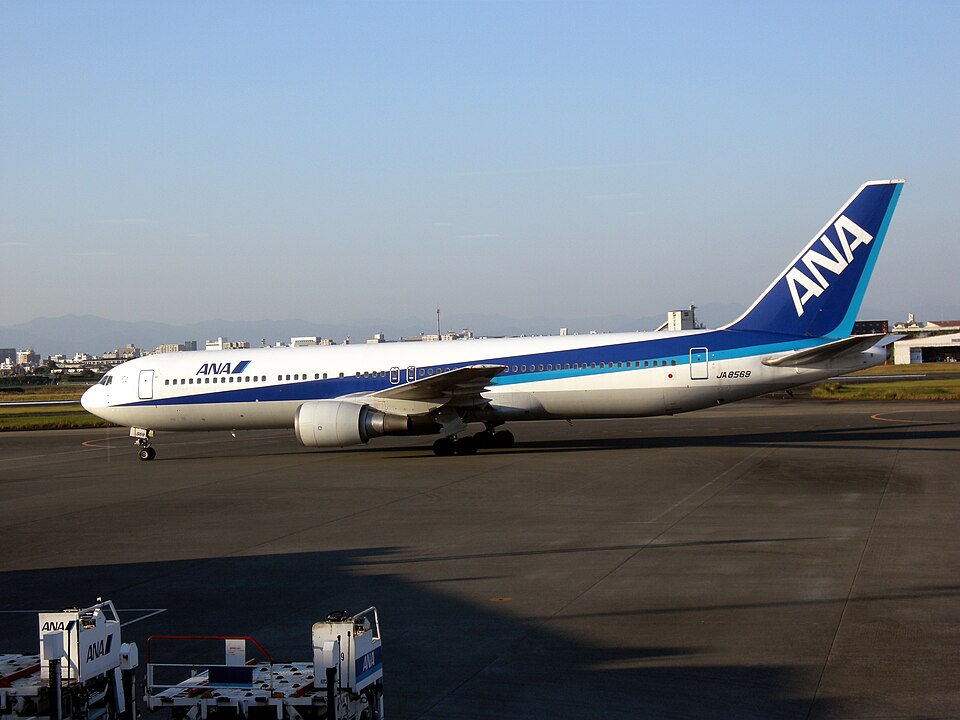
Accident Overview
On April 27, 2011, at approximately 16:53 Japan Standard Time, a Boeing 767-300 (registration JA8569) operated by All Nippon Airways as scheduled flight 610 encountered turbulence while cruising at an altitude of 25,000 ft, approximately 27 nautical miles east-southeast of Kushimoto. The aircraft had departed Miyazaki Airport at 16:16, bound for Tokyo International Airport, with 119 persons on board, including the pilot-in-command, seven other crew members, and 111 passengers.
Sequence of Events
According to records from the Digital Flight Data Recorder (DFDR) and Cockpit Voice Recorder (CVR), the aircraft initially climbed to Flight Level 270 and later to FL290, before descending to FL250. At 16:52, about one minute before the turbulence encounter, the wind velocity increased rapidly from 50 kt to 60 kt, then fluctuated. The static air temperature also fluctuated. At 16:52:37, the thrust lever was retarded, and a bump sound was recorded in the cockpit, accompanied by a vertical acceleration of –0.34 G. The pitch angle increased, and the aircraft descended 80 ft in one second. The seat belt sign was turned on at 16:52:41.
Following the turbulence, the flight crew reported moderate turbulence to air traffic control and confirmed injuries in the cabin. The aircraft subsequently descended to FL230 and later to lower altitudes, landing at Tokyo International Airport around 17:43.
Injuries and Damage
One cabin attendant sustained serious injuries after being thrown into the air and falling in front of the left aft lavatory. Four other individuals, comprising both passengers and cabin attendants, suffered slight injuries. The aircraft itself was not damaged.
Probable Cause
The Japan Transport Safety Board determined that the accident likely occurred because the aircraft encountered a sudden atmospheric disturbance, causing severe shaking. One cabin attendant was seriously injured when she was thrown up and fell to the floor. The disturbance may have been clear air turbulence (CAT) generated locally and temporarily by a wind shear near a frontal zone beneath a jet stream.