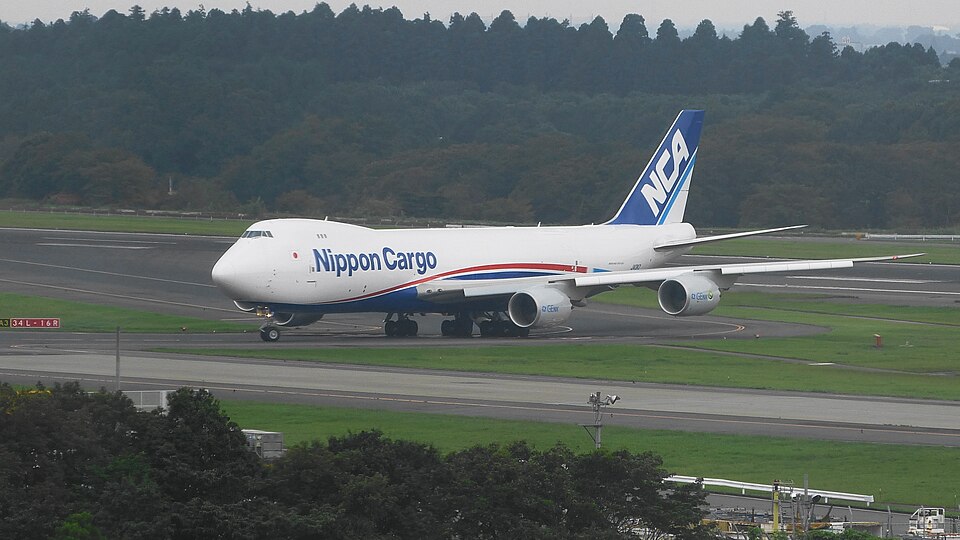
Accident Overview
On February 1, 2021, at approximately 18:51 Japan Standard Time, a Boeing 747-8F aircraft, registration JA13KZ, operated by Nippon Cargo Airlines Co., Ltd., experienced a tail strike during a go-around at Narita International Airport. The accident occurred on Runway 16R. The aircraft sustained damage to the lower aft fuselage. There were two persons on board, the pilot in command and a crewmember; no one was injured.
Flight History
The aircraft departed Hong Kong International Airport at 15:34 JST as scheduled flight 258 for Narita. The PIC was the pilot flying and the FO was the pilot monitoring. The crew had stayed overnight in Singapore but had sufficient rest and were physically fit.
During the approach, the aircraft received ATIS information indicating wind 180°/2 kt with no turbulence or wind shear. The PIC briefed a landing configuration of flap 30°, autobrake 3, and approach speed Vref+5 KIAS. The aircraft was radar-vectored for an ILS Y RWY16R precision approach. At 18:48:33, the crew inquired about surface wind and received 200°/5 kt. Landing clearance was issued at 18:49:21 with wind reported as 200°/4 kt.
At 18:50:23, the aircraft passed 500 ft AFE; the FO called “500 ft” and the PIC responded “STABILIZED.” The autopilot was disengaged at 460 ft (RA 352 ft) by the PIC. At that time, wind was recorded as 218°/22 kt, but wind velocity decreased as the aircraft descended. Upon disengagement, the rudder returned to neutral and the aircraft began to veer right; the PIC did not apply rudder initially.
At 18:50:42, the auto-throttle was deactivated. The PIC increased engine N1 from about 66% to 75–77%, causing the pitch angle to increase and the aircraft to rise above the glide slope. At the decision altitude of 330 ft, the FO called “MINIMUMS” and the PIC responded “LANDING,” transitioning to visual flight.
At 18:50:50, the aircraft was at 289 ft (154 ft AFE) with a glide slope deviation of +1.02 dots and localizer deviation of 0.2 dots right. The PIC rolled left and applied left rudder to correct, but deviations increased. At 18:50:53, glide slope deviation reached +1.59 dots. The PIC then performed nose-down inputs and reduced thrust to about 65%. Sink rate increased to 1,024 fpm at 18:50:56.
At 18:51:03, the aircraft passed the runway threshold and the PIC moved thrust levers to idle. The aircraft began to veer left; the PIC applied right rudder. The aircraft touched down but bounced, becoming unstable. The crew executed a go-around. During the go-around, the lower aft fuselage contacted the runway, resulting in damage.
Investigation
The Japan Transport Safety Board investigated the accident, with an accredited representative from the United States participating. The investigation utilized flight data recorder, quick access recorder, cockpit voice recorder, ATC communications, and crew statements. The report details the sequence of events but does not specify a probable cause.
Damage
The aircraft sustained damage to the lower aft fuselage due to the tail strike. There were no injuries.
Conclusion
The accident report provides a factual account of the tail strike event but does not attribute a specific cause.