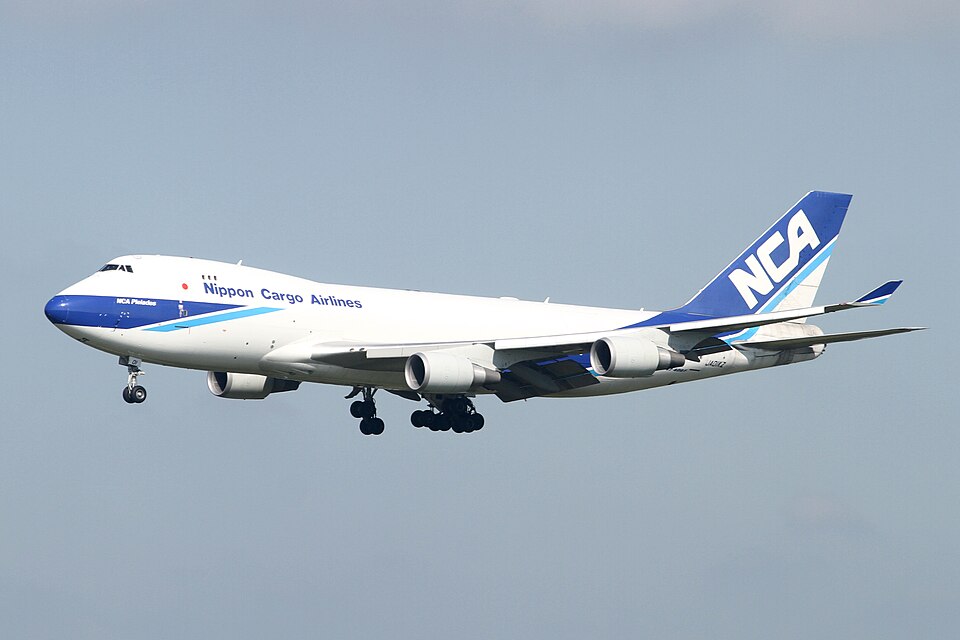
Incident Overview
On June 11, 2010, at about 21:54 Japan Standard Time, a Boeing 747-400F registered JA01KZ, operated by Nippon Cargo Airlines Co., Ltd., experienced an engine failure shortly after takeoff from Runway 16R at Narita International Airport. The aircraft was operating as scheduled cargo flight 166 to Anchorage International Airport, USA. There were three persons on board—the captain, a crewmember, and an employee of the company—none of whom were injured.
Flight History
According to the Digital Flight Data Recorder (DFDR) records and crew statements, the aircraft received takeoff clearance at 21:52:28 and began its takeoff roll at 21:52:42. The aircraft lifted off at 21:53:41 at about 190 knots. At 21:53:48, when the aircraft was approximately 140 feet above the runway and at about 200 knots, the No.1 engine's low-pressure compressor speed (N1) and high-pressure compressor speed (N2) declined rapidly. The exhaust gas temperature (EGT) initially rose then decreased as fuel flow (FF) dropped. Vibration in the No.1 engine increased to a maximum of 5 units. The aircraft veered left by about 6 degrees, which was later corrected.
The crew heard a loud abnormal noise, and the Engine Indicating and Crew Alerting System (EICAS) indicated a No.1 engine failure. The pilot flying (PF) continued climbing straight and engaged the autopilot at 21:53:58. The pilot monitoring (PM) reported the engine failure to air traffic control at 21:54:03 and requested clearance to climb to 7,000 feet. The aircraft reached 7,000 feet past 21:59, and at 22:00:36, the throttle for No.1 engine was retarded to idle; at 22:00:45, the fuel control switch was moved to cut-off, shutting down the engine. No master warning was recorded during the flight.
Engine Damage
A visual inspection and borescope inspection (BSI) revealed substantial internal damage to the No.1 engine. The extent of damage was limited to the engine; no other aircraft components were damaged.
Aftermath and Return
After shutting down the No.1 engine, the crew decided to return to Narita Airport. They flew to the VENUS reporting point to jettison fuel, releasing about 150,000 pounds of fuel over approximately 45 minutes while maintaining 7,000 feet under radar vectoring. The aircraft then landed safely on Runway 16R at 23:08 using the remaining three engines. The crew did not declare an emergency, as the aircraft remained fully controllable.
Investigation
The Japan Transport Safety Board conducted an investigation, with an accredited representative from the United States (as the state of design and manufacture) participating. The investigation included aircraft and engine examinations, flight crew interviews, a teardown inspection of the engine in Taiwan, and detailed examination of stage 1 high pressure turbine blades at a laboratory in the USA. Factual information was provided to the Civil Aviation Bureau of Japan.