Incident Overview
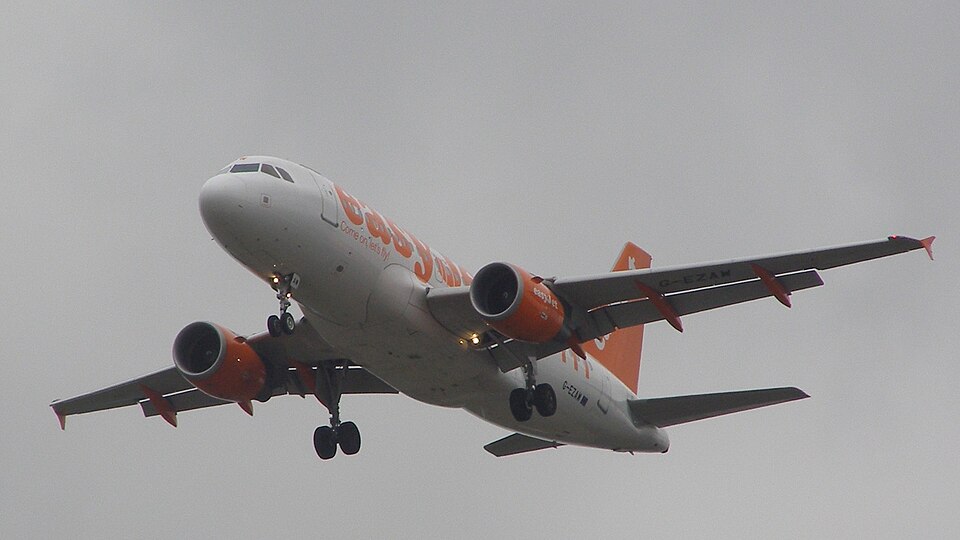
On 3 July 2017, an Airbus A319-111, registration G-EZAW, operated by a commercial airline on a scheduled passenger service from Edinburgh to Munich, experienced a serious incident during landing at Munich Airport. The aircraft was on an Instrument Landing System (ILS) approach to Runway 26L when the commander's Flight Management Guidance Computer (FMGC1) failed at approximately 1,500 ft above aerodrome level.
Emergency Actions
The crew were unable to modify the target approach speed through either the FMGC or the Flight Control Unit. At 1,288 ft, the engines began to spool up without command, prompting the pilot flying to disconnect the autopilot and autothrust. The remainder of the approach was flown manually with manual thrust. During the approach, a cabin pressure landing elevation fault was triggered, believed to be associated with the FMGC1 failure.
Landing and Impact
As the aircraft neared the touchdown point, the pilot flying applied a nose-down sidestick input, reducing the pitch attitude. The aircraft touched down firmly with a relatively flat attitude. The maximum recorded vertical acceleration was 3.01 g, classified as a Severe Hard Landing. A LOAD<15> report was automatically generated, indicating the landing parameters were exceeded.
Damage and Inspection
Post-flight inspection revealed damage to the nose landing gear and right main landing gear, along with cracking of paint and sealant in the nose gear bay and avionics bay. All three landing gear legs were replaced as a precaution. Detailed examination found the nose landing gear shock-absorber cylinder buckled and the right main landing gear sliding tube and shock-absorber out of tolerance. The left main gear was undamaged.
Recorded Flight Data
Flight data recorder analysis showed the aircraft was on a stable ILS approach until the autopilot and autothrust were disconnected at 1,228 ft radio altitude. From 30 ft, a forward sidestick input lowered pitch attitude to nearly 1° nose-down less than a second before touchdown. The rate of descent at touchdown was 11.9 ft/sec. The commander, focusing on the runway, called out "watch it" about 0.5 seconds before impact but could not react in time.
Meteorological and Airfield Conditions
The weather at the time was clear with a surface wind of 290° at 2 kt, temperature 20°C, and pressure 1022 hPa. The runway was 4,000 m long with full approach lighting and a 3° PAPI. The aircraft landed during civil twilight, defined as daylight under EASA rules.
Personnel
The co-pilot, with 1,644 hours on type, was the pilot flying. The commander had 11,179 total hours, with 9,300 on type. The commander was initially handling the FMGC1 failure and did not notice the nose-down input until it was too late.
Conclusion
The incident was attributed to both pilots failing to recognize the incorrect landing attitude until corrective action was no longer possible. Distractions and high workload from the FMGC1 failure may have contributed to the nose-down pitch input made immediately before touchdown.