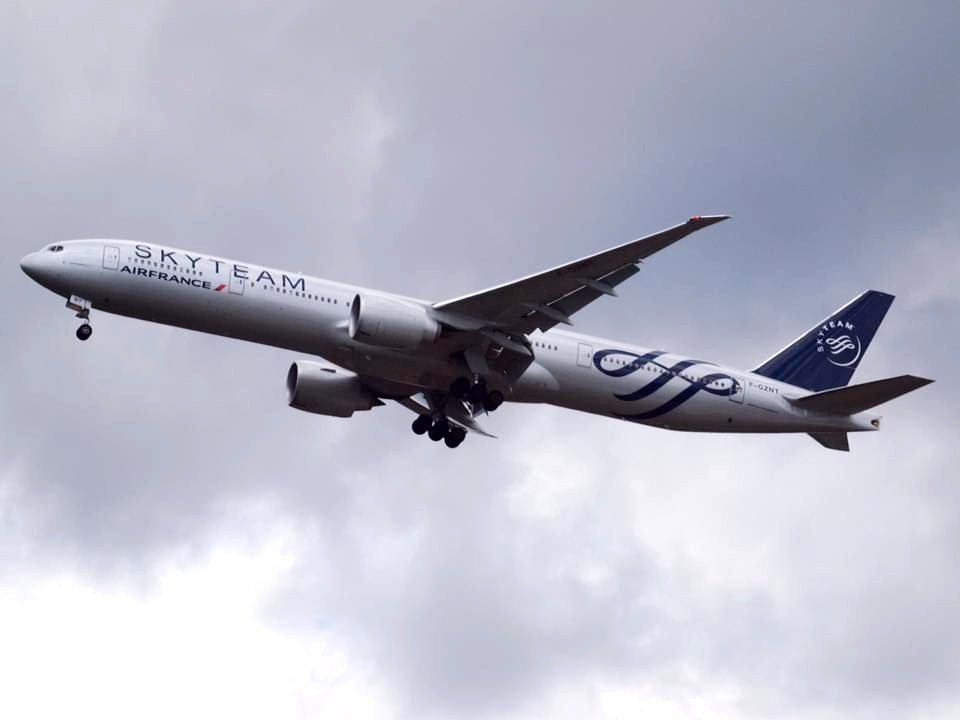
Incident Overview
On May 11, 2016, at 07:34 UTC, a collision occurred on the ground at Paris Charles de Gaulle Airport (95) between two aircraft operated by Air France. The involved parties were a Boeing 777 with registration F-GZNT, which was being towed without engines running, and an Airbus A320 with registration F-GKXJ, which was taxiing under its own power for flight AF1084 to Tunis.
Operational Context
At the time of the incident, weather conditions included low visibility, with a Runway Visual Range (RVR) of 250 meters. Air traffic controllers were managing ground traffic using ground radar due to limited visual contact. The A320 was positioned at holding point CAT III T4 on taxiway R, while the towed 777 was approaching from behind.
Sequence of Events
The ground controller, working with an instructor, initially instructed the 777's convoy agent to maintain position because radar precision did not allow for a safe determination of whether the 777 could pass behind the A320. Two minutes later, the controller asked if the 777 could proceed. The convoy agent consulted the tow operator, who decided to advance slowly and steer right to pass. The controller was not informed of this specific maneuver. At 07:33 UTC, the left wingtip of the 777 struck the vertical stabilizer and rudder of the A320.
Damage and Aftermath
The collision caused damage to the extreme tip of the 777's left wing and the tail assembly (vertical fin and rudder) of the A320. The A320 was subsequently towed to a parking stand for passenger deplaning. Firefighters arrived at 07:37 UTC to assess the situation, confirming that the damage was limited to structural shearing of the tail.
Contributing Factors and Analysis
The investigation highlighted difficulties in estimating distances between aircraft wingtips and other obstacles during ground operations, particularly in low visibility. The tow operator noted that while they could see the wingtips when turning around, the collision occurred before they could re-verify clearance. Additionally, the 777's cockpit voice recorder was not active because engines were off, as per standard towing procedures at the time. Following this event, Air France considered requiring CVR activation during all towed movements.