Incident Overview
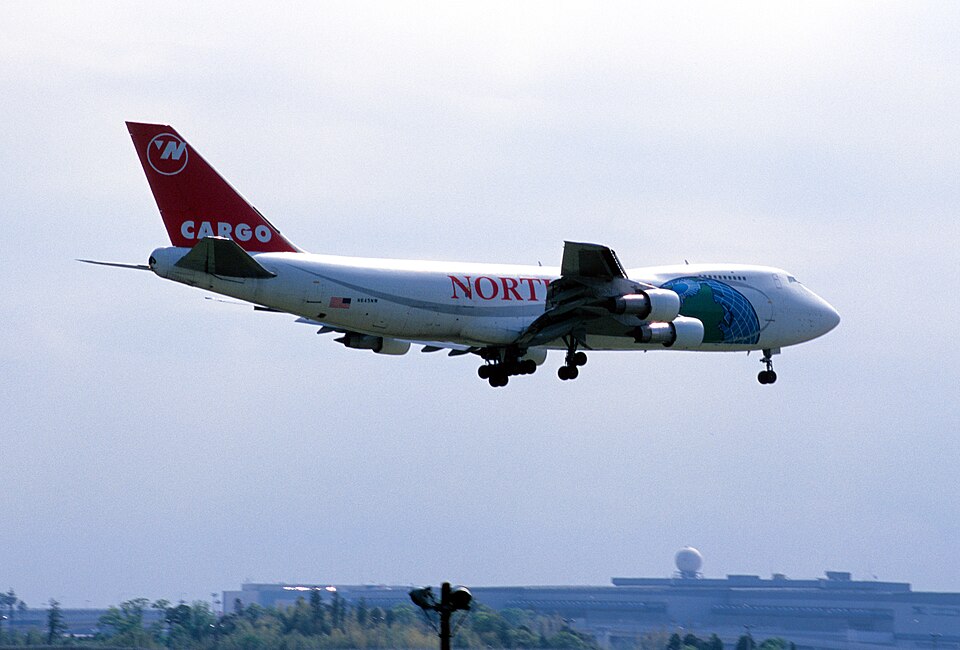
On July 29, 2004, Northwest Airlines (NWA) Flight 905, a Boeing 747-200B registered as N645NW, operated a scheduled cargo service from Kansai International Airport, Japan, to Inchon International Airport, Seoul, Korea. The aircraft departed at 11:32 JST. Shortly after takeoff, at approximately 300 feet above ground level, the crew observed abnormal indications from the No. 1 (left outer) engine, including a rise in exhaust gas temperature and loss of thrust. The aircraft yawed left, and the crew performed the engine failure drill. They declared an emergency and returned to Kansai International Airport, landing uneventfully at 11:44 JST.
Aircraft and Engine Damage
Inspection revealed damage confined to the No. 1 engine, a Pratt & Whitney JT9D-7R4G2. The engine cowling exhibited key-shaped damage and four small holes near the 5 o'clock position. The high-pressure turbine case had a hole approximately 4 cm by 2 cm near the attachment flange to the low-pressure turbine case, also at the 5 o'clock position. The case cooling manifold was damaged, and metal flakes that had melted and solidified were found on the engine exhaust outlet. No other aircraft damage was reported.
Crew and Flight Details
Three crew members were on board: a captain aged 52, a first officer aged 45, and a flight engineer. All held valid licenses and medical certificates. No injuries occurred. The flight had been planned as an IFR cargo flight with an estimated en route time of 1 hour 20 minutes. During preflight, the No. 1 and No. 2 engines required restarting after their revolutions did not stabilize, but all engines operated normally until takeoff. The crew reported a loud rasping noise and yawing at the time of failure. The air traffic controller in the Kansai Tower witnessed the aircraft and coordinated its return after the crew declared an emergency.
Investigation
The Aircraft and Railway Accidents Investigation Commission (ARAIC) investigated the incident, with participation from the United States as the state of design and manufacture. Analyses of the digital flight data recorder and cockpit voice recorder, as well as detailed engine examinations, were conducted. The report did not state a probable cause.