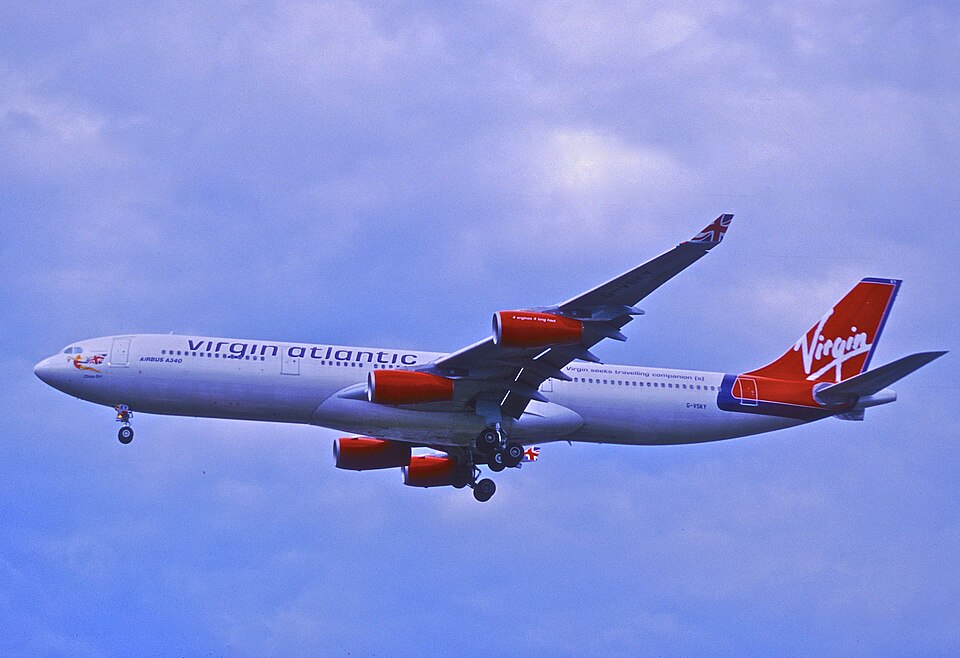
On January 30, 2003, an AIRBUS A340-311 (registration G-VSKY) was involved in an aviation accident near London Heathrow Airport, GB. This summary draws on records from the UK Air Accidents Investigation Branch (AAIB); 8 related events involving the same aircraft type or operator are linked below.
On 30 January 2003, an Airbus A340-311, G-VSKY, slid on an icy taxiway at London Heathrow while lining up on Runway 27R. The right main gear left the pavement, delaying passenger disembarkation by 2.5 hours.
Incident Overview On 30 January 2003 at 2326 UTC, an Airbus A340-311, registration G-VSKY, was taxiing at approximately 6 knots to line up on Runway 27R at London Heathrow Airport. The aircraft began to slide on ice and snow, and despite the application of asymmetric thrust, the right main landing gear left the paved surface and sank into soft grass. No injuries or damage were reported. The flight, a public transport operation, carried 14 crew and 130 passengers. ## Flight and Operational Context The aircraft was scheduled to depart for Newark, USA. The commander, a 50-year-old airline transport pilot with 15,764 total hours, had completed a cold weather operations briefing due to poor conditions at Heathrow. The aircraft was de-iced and pushed back at 2308 UTC with an all-up weight of 204,464 kg. During taxiing, the crew observed that the taxiway edges were contaminated with ice and snow, although the centreline markings were clear. ## Manoeuvring and Slide When cleared to line up on Runway 27R, the commander taxied forward and attempted a left turn. Both pilots noted the rear of the aircraft beginning to slide. The commander applied a small amount of power to the right engines to correct the slide but did not apply the brakes, as anti-skid was unavailable below 10 knots. A strong northerly wind assisted the slide. The right main gear left the pavement and sank approximately 50 cm into the grass. The flight crew shut down the right-hand engines due to the resulting right-wing-low attitude. ## Post-Incident Response Air traffic control dispatched airfield operations and rescue and fire fighting services. Fire crews parked at a distance due to icy conditions. The crew installed gear pins in the right main gear via the cockpit windows, started the auxiliary power unit, and shut down the remaining engines. Passenger disembarkation was delayed by 2.5 hours while de-icing equipment was brought in and the taxiway was de-iced. Departing aircraft during this period threw snow back over the holding area. ## Recorded and Meteorological Data Quick access recorder data supported the commander's account. The aircraft moved forward for about 10 seconds, accelerating to 4 knots, then turned left with the nose wheel at full deflection for the final 20 seconds of movement. A brief, slight increase in power was recorded on the right engines, with a maximum speed of 6 knots. The 2320 UTC METAR reported a surface wind of 340°/18 kt gusting to 28 kt, visibility greater than 10 km, few clouds at 2,200 ft, scattered cloud at 6,000 ft, a temperature of -0°C, and a dew point of -5°C. ## Ground Operations and Regulatory Context Runway 27R had been de-iced and made available at 2225 UTC. Taxiways were de-iced three times during the day, with the last logged at 1930 UTC. However, the log did not reflect the de-icing times for specific holding areas such as Blocks 137, 134, and 133. Photographs taken after the incident showed extensive ice on the taxiway surfaces in the holding area. Civil Aviation Publication 168 requires measurement and reporting of runway surface friction conditions but does not extend the same requirement to taxiways. No such measurements were made before or after the incident. ## Safety Recommendation The incident led to Safety Recommendation 2003-51, which advised the CAA to review the guidance material for dealing with winter contamination of aerodrome surfaces in CAP 168 to ensure that conditions on all aerodrome manoeuvring areas are fit for use by aircraft.