Background
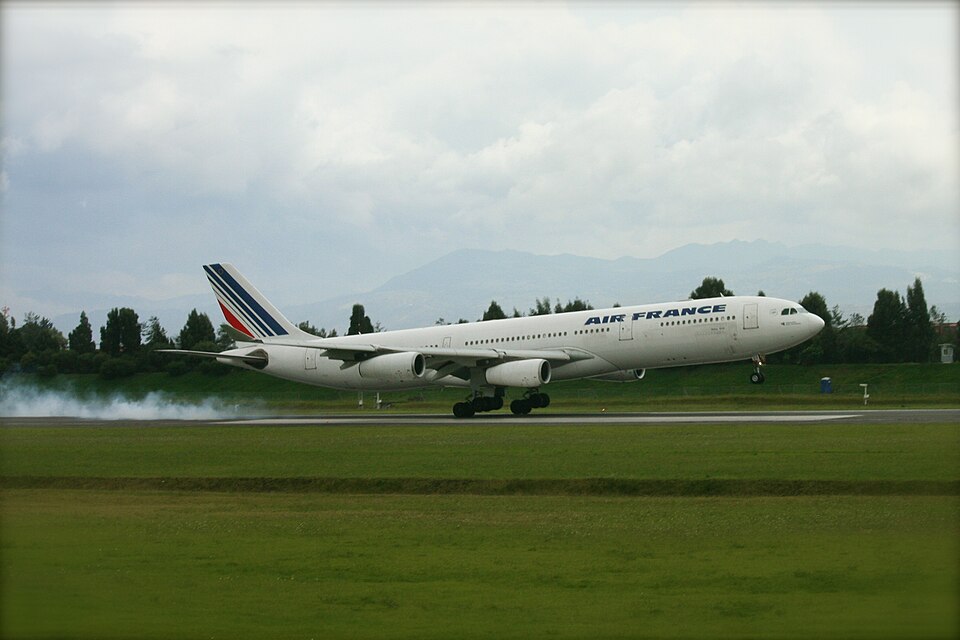
On 19 August 2017, at 01:16 UTC (20:16 local time), Air France flight AF429, an Airbus A340-313 registered as F-GLZO, experienced a serious incident during takeoff from runway 13R at Bogotá El Dorado Airport in Colombia. The flight was a commercial passenger service to Paris Charles de Gaulle, with a crew consisting of a commander (pilot monitoring), two first officers (one pilot flying, one reserve), and seven cabin crew members, carrying 219 passengers.
Pre-Flight Preparation
The crew prepared the flight at the operations room. Due to the airport's altitude and temperature, runway length limited takeoff performance and payload. During preparation, weather conditions and rain prevented loading all baggage and required fuel; the aircraft's mass would have exceeded the maximum takeoff mass by four tons, corresponding to all passenger baggage. The crew consulted the operator's Operations Control Center, which advised waiting for conditions to improve.
Identified risks included: a possible engine temperature limitation triggering an engine failure procedure; wind changes affecting performance and reducing margins for takeoff distances and obstacle clearance; and nearby elevations requiring careful trajectory monitoring.
Weather improved, with outside temperature dropping from 18°C to 15°C, allowing the crew to load all planned cargo.
Holding at Runway 13R
The aircraft arrived at the holding point for runway 13R at 00:51 UTC. After about 10 minutes, the crew shut down two engines. The controller asked if they could depart with a thunderstorm over the airport; the crew replied no. A conversation in Spanish between the controller and an Avianca flight (Avianca9257) ensued; the controller said he could not see the storm, and the Avianca flight accepted takeoff. The AF429 crew, not speaking Spanish, could not follow.
One minute later, without instructions, the crew demanded an explanation. The controller cleared them to line up. The crew responded they needed to restart the engines.
The Avianca9257 crew, at the controller's request, reported rain at the end of the runway, no other weather phenomena—this conversation in Spanish. The AF429 commander stated they observed preceding aircraft on the Navigation Display; none altered course after takeoff, which could have indicated a storm.
At 01:09 UTC, about 18 minutes after arriving at the holding point, the crew reported ready for departure. The controller acknowledged and asked them to wait. About two minutes later, the crew, not yet cleared to line up, expressed confusion. They then received clearance to line up behind Avianca9831.
Avianca9831's crew reported to the controller "quite heavy rain in the last quarter of the runway" after departure—this conversation in Spanish, not relayed in English. About 45 seconds later, 24 minutes after arriving at the holding point, AF429 received takeoff clearance. The commander noted the windsock indicated calm wind at takeoff.
Takeoff and Wind Shear Encounter
At 01:15:53 UTC, the crew initiated takeoff with brakes released and thrust levers at TOGA, flaps 3, as per operator's Bogotá procedures. The wind measured at the runway start was 211° at 1 kt.
During the takeoff roll, available data did not allow wind estimation until the aircraft reached about 110 kt calibrated airspeed (CAS). Between 110 kt and rotation speed (VR) of 138 kt, headwind increased from 3 kt to 11 kt.
At 138 kt, the pilot flying commenced rotation with approximately ¾ of the side-stick's free travel. Between rotation start and main gear liftoff, wind shifted from 11 kt headwind to 12 kt tailwind, and CAS dropped 6 kt.
After liftoff, tailwind continued increasing to 25 kt; vertical wind also increased to 4 kt downward. Pitch angle remained between 11° and 13°, and CAS decreased to a minimum of 128 kt.
Six seconds after liftoff, the Flight Management Guidance and Envelope Computer (FMGEC) detected wind shear, triggering a red "WINDSHEAR" message on the Primary Flight Display and a repeated audible warning for 15 seconds. At that moment, CAS was 128 kt, 13 kt below the minimum selectable speed (VLS). Height stabilized at about 5 ft while the pilot flying applied nose-up input, reaching a pitch angle of 13°. The crew left thrust levers at TOGA and did not change configuration. Angle of attack increased until alpha protection activated, remaining active for four seconds. Tailwind then decreased, and CAS and climb rate increased.
The runway threshold was overflown at 58 ft, above the regulatory 35 ft. Obstacles in the approach area were cleared with sufficient margin.
Twenty-one seconds after liftoff, the wind shear warning ceased at 193 ft, pitch decreasing from 13°. Five seconds later, at 258 ft, CAS reached V2 (145 kt).
Aftermath
Upon leaving the frequency, the crew reported the wind shear to the controller, who acknowledged. About 30 seconds later, the crew requested to maintain position for three minutes due to the wind shear. They continued the climb while avoiding multiple storms and completed the flight without further incident.
The activation of a high-angle-of-attack protection near the ground and the operational limitations of Bogotá Airport for the A340-300 led the BEA to classify this incident as serious.