Incident Overview
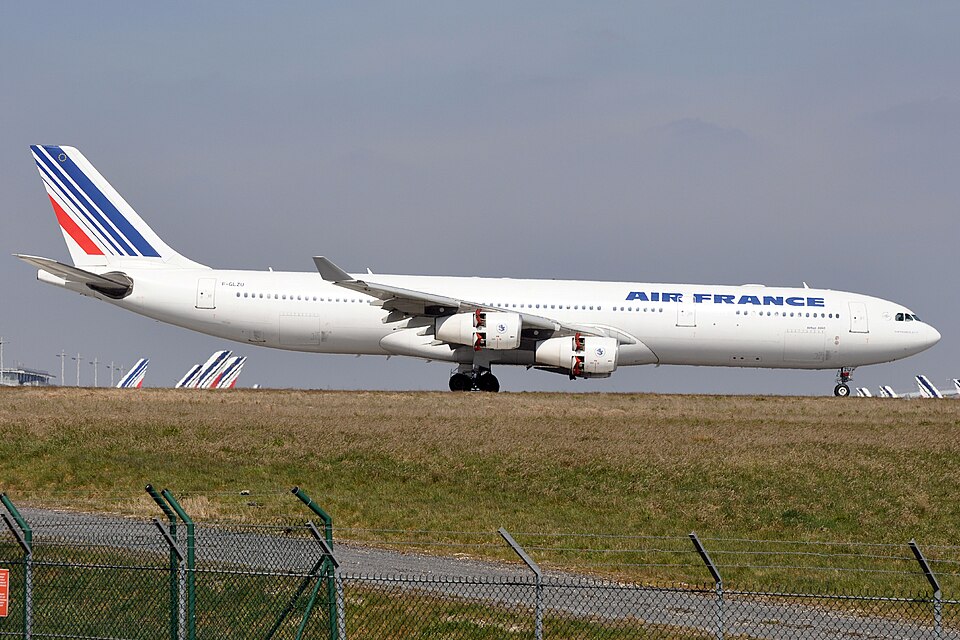
On 11 March 2017, an Airbus A340-313E, registered F-GLZU and operated by Air France, was conducting flight AF423 from Bogotá Eldorado Airport (Colombia) to Paris Charles de Gaulle Airport (France). The aircraft carried 268 passengers and 13 crew members. The captain served as the pilot flying (PF) for this leg.
Take-Off Sequence
The take-off was performed at night from runway 13R, which is 3,800 m long with a 300 m clearway. At 23:54 UTC, the crew applied 50% thrust on brakes and then selected full thrust (TOGA). The captain initiated rotation when the calibrated airspeed reached the rotation speed (VR). At that moment, the aircraft was 2,760 m from the runway 13R threshold. The rotation rate was slow, and all three crew members reported hearing the audio warning "PITCH PITCH." The main landing gears lifted off when the aircraft was 140 m from the opposite runway threshold. The aircraft crossed the opposite threshold at a radio altimeter height of 6 ft and the end of the clearway at 20 ft, with a speed of V2 + 9 kt. It cleared the ILS antennas, the first obstacle, by 12 ft vertically. The climb continued without further incident, and regulatory obstacle clearance margins were met.
Investigation Findings
The investigation determined that the serious incident resulted from insufficient nose-up inputs by the pilot flying, which lengthened the take-off distance by 424 m compared to the certified theoretical take-off distance plus regulatory safety margins under the day's operational conditions. Consequently, the risk of a runway overrun or collision with obstacles was significantly increased. Under the conditions of the incident, the initial nose-up input held at the typical value recommended by the Flight Crew Training Manual (FCTM)—two-thirds of the backward deflection—was insufficient to achieve the rotation rate of 3° per second assumed in the certified performance model and also mentioned in the FCTM.
Prior Identification Gap
Before this event, the discrepancy between rotation rates achieved in operations and those used in performance calculations had not been identified by operators of the Airbus A340-300 due to the absence of air safety reports and monitoring of take-off performance during flight data analysis.
Safety Measures and Recommendations
Following the incident, Air France, Lufthansa, Airbus, and the European Aviation Safety Agency (EASA) adopted safety measures, which were communicated to the BEA. Based on the investigation and these measures, the BEA issued seven safety recommendations to EASA concerning the certification of take-off performance, management of risks related to long take-offs, and the flight analysis program.