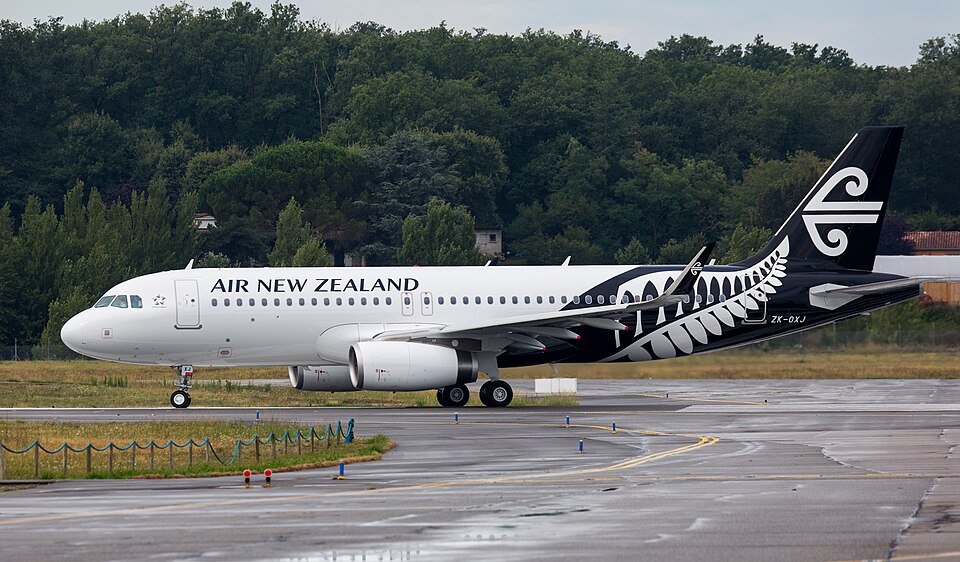
Incident Overview
At approximately 1815 New Zealand Daylight Time on 2 April 2024, an Airbus A320-232, registration ZK-OXJ, operated as Air New Zealand flight NZ562 from Christchurch to Auckland, was on an instrument approach for runway 23L at Auckland Airport. The aircraft was at 2000 feet above mean sea level and about 7 nautical miles from the runway threshold, inside the Auckland Control Zone. The flight crew reported seeing a drone pass close to the aircraft. Both pilots observed the drone first slightly to the right (north) of the aircraft, then passing over the top of the flight deck towards Ardmore to the south. The crew confirmed no collision occurred by watching the drone track away. The drone was described as "about the size of a duck" and partly filled the front windscreen at its closest. The pilot reported the sighting to the Auckland tower controller, who closed that segment of airspace for 15 minutes in accordance with Airways Corporation procedures. As of the report date, the drone pilot had not been identified by Police, the Civil Aviation Authority of New Zealand (CAA), Airways, or the Transport Accident Investigation Commission.
Aircraft and Crew
The aircraft involved was an Airbus A320-232, ZK-OXJ, operated by Air New Zealand. The flight crew comprised a captain and a first officer, both Auckland-based and appropriately qualified. The first officer was the pilot flying, and the captain was the pilot monitoring for the Christchurch-to-Auckland leg, which was the last of four sectors that day.
Meteorological Conditions
Both pilots reported weather suitable for a visual approach from about 2700 feet, with patchy cloud, no rain, light wind, and excellent visibility.
Drone Operations and Regulations
The term 'drone' encompasses a broad range of devices including Remotely Piloted Aircraft Systems (RPAS). In New Zealand, drone operations are governed by Civil Aviation Rules Part 101 and Part 102. Part 101 sets baseline rules, allowing drone flights in controlled airspace only with Air Traffic Control permission, except for shielded operations. Part 102 permits less-restricted operations for certified operators. The Airshare website and app allow drone pilots to request ATC authorization. For sensitive areas like near Auckland airport, ATC approval is unlikely unless the operator holds Part 102 certification and has a legitimate reason. The report notes that as of its writing, there was no universal mechanism to identify drone operators in New Zealand.
Data on Drone Incidents
Airways data from January 2019 to the end of 2024 recorded 367 reported airspace incidents involving drones, including 57 in Control Areas, with a maximum reported height of 8000 feet. These incidents resulted in 36 delayed or cancelled flights and 5 go-arounds. CAA data from 2015 to 2024 returned 5297 drone-related occurrences. Of these, CAA initiated action in response to 1938 incidents. The report indicates the number of incidents across all aerodromes, including hospital heliports, suggests a systemic issue proportional to population density. CAA reported conducting educational and enforcement activities, including sending educational letters for low-risk events and proactive campaigns like 'Share the skies' from 2020 to 2024.