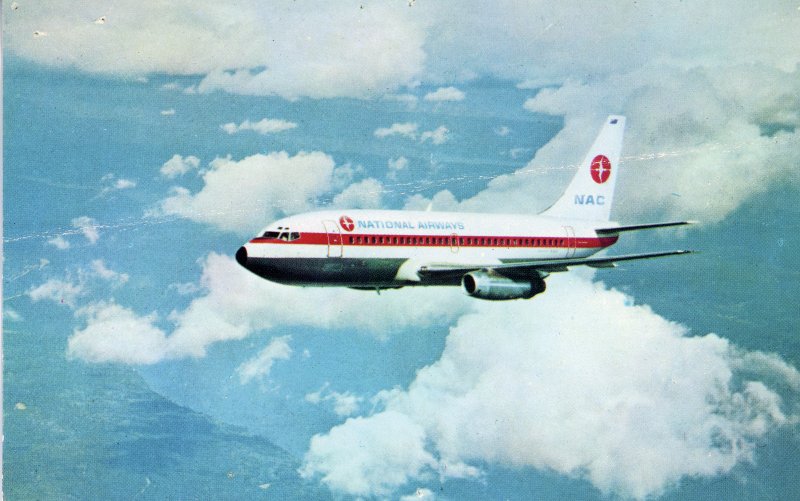
On December 2, 1995, a Boeing 737-200 (registration VT-ECS) operated by Indian Airlines was involved in an aviation accident near New Delhi-Indira Gandhi, India during landing or approach. No fatalities were reported. Investigators recorded the probable cause as: The accident was the consequence of the combination of the following factors: - The injudicious and imprudent decision of the Pilot-in-Command to hastily complete the flight in the inadequate time available before the notified closure of Delhi airport for a… This summary draws on records from the Bureau of Aircraft Accidents Archives (B3A); 10 related events involving the same aircraft type or operator are linked below.
Photo: San Diego Air & Space Museum Archives / Public domain, via Wikimedia Commons
An aircraft landed too far down the runway at Delhi airport, overran, struck a concrete wall, and was destroyed. All 108 occupants evacuated safely. The investigation cited an unstabilized approach and multiple crew errors.
Event
The aircraft was configured incorrectly during the approach, resulting in a landing approximately 600 metres from the end of the runway. After touchdown, the crew was unable to stop within the remaining distance. The aircraft overran the runway, struck a concrete wall 45 centimetres high, and came to rest 450 metres beyond the wall. The aircraft sustained damage beyond repair, but all 108 occupants evacuated safely.
Probable Cause
The official investigation determined the accident resulted from a combination of factors:
The pilot-in-command's injudicious and imprudent decision to complete the flight hastily before a notified closure of Delhi airport for a VVIP flight.
A dangerously unstabilized approach, primarily due to the pilot-in-command's failure to decelerate the aircraft in time.
The first officer's failure to call out significant deviations from the stipulated approach parameters.
The pilot-in-command's failure to execute a missed approach despite the grossly unstabilized approach.
The inadvertent omission by the pilot-in-command to arm the speed brake before landing.
Touchdown at excessive speed and too far down the runway.
Failure of both pilots to monitor automatic speed brake deployment and the pilot-in-command's failure to deploy it manually.
Impact with an 18-inch-high cement-concrete cable duct in the unpaved area beyond the overrun.
The pilots' disregard of procedures, regulations, and instructions.
An X-AIR HAWK ultralight crashed in Chonburi, Thailand, killing the pilot and injuring a passenger. The accident was caused by deteriorated wing fabric and…
A Challenger II Special ultralight aircraft (U-B23) landed off-runway at Pai Airport, Mae Hong Son, on September 17, 2024, due to a gust of wind. No injuries…
The Polish aviation safety authority is investigating a serious incident involving an AT-3R100 aircraft that occurred on September 2, 2024. The investigation…
A SZD-48-3 glider suffered damage when its left wing struck a ground obstacle during a low final approach at EPWK on June 20, 2025. The pilot was uninjured.
A 39-year-old skydiver died after a hard landing near Leszno on May 1, 2026. The PKBWL preliminary report indicates the fatal impact resulted from a late,…
A student pilot crashed an SZD-50-3 Puchacz glider into the airfield fence during a solo training flight on June 6, 2026. The pilot was uninjured, but the…