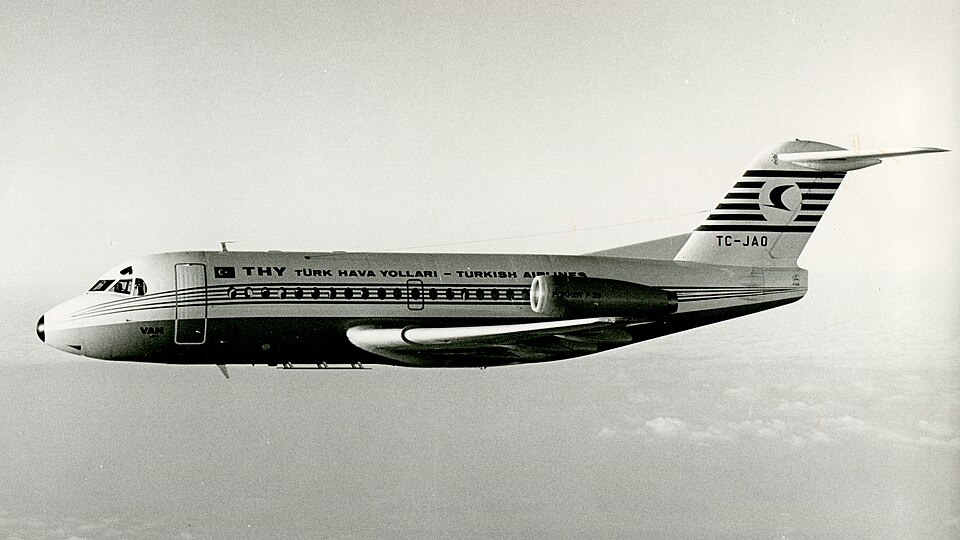
Accident Sequence
After closing the doors and receiving tower permission, the aircraft taxied to the threshold of Runway 35 and began a rolling takeoff without delay. Witnesses reported that the aircraft ran approximately 3,200 feet before becoming airborne. When about 8 to 10 meters above the ground, it yawed to the left and pitched nose-down. The aircraft contacted the ground in a nearly level attitude, first by the outboard fairing doors of the left wing flap, then by the left side of the fuselage belly, striking the bank of a drainage ditch that parallels the left side of the runway at a distance of 28 meters. The aircraft then disintegrated and caught fire within 100 meters of travel. One crew member and six passengers survived; 66 other occupants were killed.
Investigation Findings
The official investigation determined that the aircraft stalled on takeoff due to over-rotation and frost accretion on the wings. The aircraft had remained overnight at Cumaovasi Airport in an open area. On the morning of 26 January at 0400 GMT, the temperature was 0°C with 95% relative humidity. By the time of takeoff, the temperature had risen to +3°C and humidity to 97%. In those weather conditions, some frost accretion existed on the upper wing surfaces and elevators. Similar frost was observed on another F28 aircraft waiting at the apron the next day under almost identical meteorological conditions.
During the pre-takeoff walk-around inspection, frost formation was not noticed. The investigation noted that the temperature on the wings and tail of an aircraft parked overnight in the open could be even lower due to radiation. The runway length at Cumaovasi is 6,005 feet. Based on temperature and aircraft load, a takeoff run of 2,800 feet was required to reach V1 and VR. Data from the flight data recorder indicated that the aircraft became airborne after a 3,200-foot run at a speed of 124 knots. The speed then reached 133 knots before dropping to 124 knots as the aircraft veered left. This indicates that the aircraft was rotated more than the normal angle of attack. It is believed that the frost accretion on the wings caused the aircraft to stall soon after takeoff, whereas it would have flown safely under normal conditions. Due to the low altitude after takeoff, the pilot could not recover from the stall.