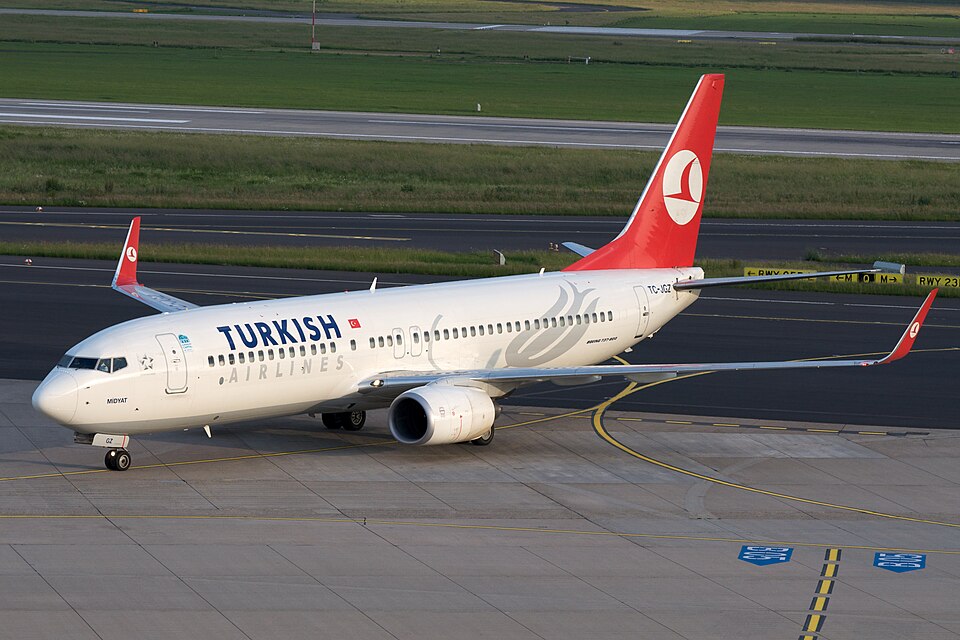
Incident Overview
On November 21, 2019, Turkish Airlines flight THY2UT, operated by a Boeing 737-800 with registration TC-JGZ, experienced a runway excursion during landing at Odesa International Airport. The aircraft, which departed from Istanbul Airport at 17:33, landed at 18:55. There were 136 passengers and 2793 kg of luggage on board. The flight crew consisted of a pilot-in-command (PIC) serving as pilot flying, a co-pilot as pilot monitoring, and four flight attendants.
Approach and Landing
The approach was conducted to runway 16 using the ILS system. Crosswind conditions were significant with variable directions. The aerodrome control tower cleared the aircraft for landing, which the crew acknowledged. From approximately 50 meters above ground, the crew executed a go-around due to the aircraft not being stabilized. After the go-around, the aircraft proceeded to a holding area to await more favorable wind conditions. At 18:45, the PIC decided to attempt a second approach, informing the ATC controller. At 18:51, the crew received landing clearance again.
Runway Excursion
At 18:55, after touchdown, the aircraft began to deviate left during the landing roll and veered off the runway onto a cleared, graded area. After traveling 550 meters on soil, the aircraft returned to the runway with its right main landing gear and nose section; during the soil movement, the nose landing gear collapsed. The aircraft came to a stop 1612 meters from the runway threshold.
Emergency Evacuation and Damage
The crew initiated an emergency evacuation of passengers. The aircraft sustained significant damage to the nose fuselage and left engine. No injuries were reported among passengers or crew.
Probable Cause (Official Findings)
The official investigation determined that the cause of the runway excursion was failure to maintain directional control during the landing run under strong crosswind conditions. Contributing factors included the crew's use of the Touchdown in Crab technique (not recommended by FCTM B-737NG for dry runways in strong crosswinds), untimely and insufficient corrective actions, the presence of a significant crosswind component, and an omnidirectional wind shift from cross-headwind to cross-tailwind during the landing roll.