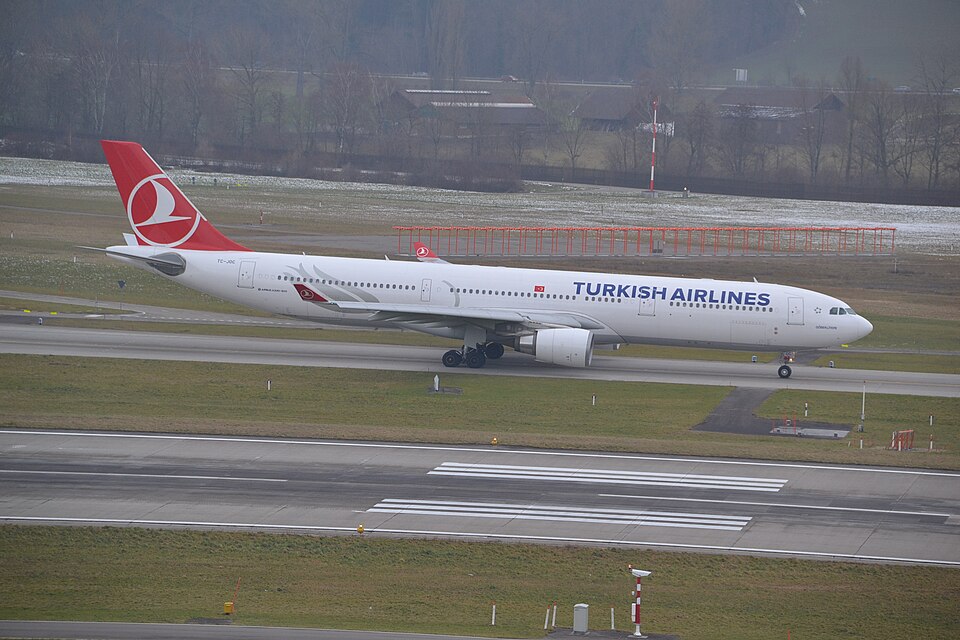
On March 4, 2015, an Airbus A330 (registration TC-JOC) operated by Turkish Airlines - THY Türk Hava Yollari was involved in an aviation accident near Kathmandu-Tribhuvan, Nepal during landing or approach. No fatalities were reported. Investigators recorded the probable cause as: The decision of the flight crew to continue approach and landing below the minima with inadequate visual reference and not to perform a missed approach in accordance with the published approach procedure. This summary draws on records from the Bureau of Aircraft Accidents Archives (B3A); 16 related events involving the same aircraft type or operator are linked below.
A scheduled flight from Istanbul to Kathmandu made a missed approach due to low visibility, then continued below minima and touched down left of centerline, crossing taxiways and stopping on grass. All passengers evacuated safely; the aircraft was damaged beyond repair.
Flight Operations and Initial Approach Attempts The aircraft departed Istanbul at 1818LT on March 3 for a scheduled flight to Tribhuvan International Airport (TIA) in Kathmandu, carrying 11 crew members and 224 passengers. Early contact attempts with Kathmandu Control between 00:02 and 00:11 were unanswered because the unit was not yet in operation; the airport opened at its scheduled time of 00:15. The flight established first contact with Kathmandu Approach at 00:17 and reported holding over Parsa at FL 270. Approach reported visibility of 100 meters and the airport status as closed. At 00:22, the crew requested to proceed to Simara due to moderate turbulence. Approach instructed a descent to FL 210 and to proceed to Simara and hold. ## Missed Approach and Second Approach Clearance At 01:05, Kathmandu Approach provided an updated visibility of 1,000 meters and asked for the crew’s intentions. The crew reported ready for an RNAV (RNP) approach to runway 02 and was cleared for an RNP AR approach. At 01:23, the aircraft reported Dovan and was instructed to contact Kathmandu Tower. Tower issued a landing clearance at 01:24 with wind 100° at 03 knots. At 01:27, the aircraft executed a missed approach due to lack of visual reference and was cleared to proceed to RATAN hold via MANRI, climbing to 10,500 feet per the missed approach procedure. ## Descent Below Minima and Runway Excursion At 01:43, the crew requested the latest visibility. Approach reported 3,000 meters, while Tower observed 1,000 meters toward the southeast, with few clouds at 1,000 feet, scattered clouds at 2,000 feet, and broken clouds at 10,000 feet. At 01:44, the crew reported its intention to continue the approach, and Approach cleared the aircraft for an RNAV RNP approach to runway 02, instructing it to report RATAN. The aircraft reported crossing 6,700 feet at 01:55. Tower cleared the aircraft to land and provided wind 160° at 04 knots. At 01:57, Tower asked whether the runway was in sight; the crew responded that it could not see the runway but was continuing the approach. The aircraft was at 880 feet AGL at that time. At 783 feet AGL, the crew asked whether the approach lights were on; Tower confirmed they were on at full intensity. The autopilots remained coupled until 14 feet AGL, when they were disconnected and a flare was attempted. The flight data recorder recorded a maximum vertical acceleration of approximately 2.7 G. The pitch at touchdown was 1.8 degrees nose up, lower than a normal flare attitude for other landings. Physical evidence and GPS coordinates indicated the aircraft touched down to the left of the runway centerline, with the left main gear off the paved runway surface. The aircraft crossed taxiways E and D and came to rest on the grass area between taxiway D and C, with a heading of 345 degrees (north-northwest) and position N 27° 41' 46'', E 85° 21' 29''. ## Post-Impact Response and Outcome At 02:00, Tower asked whether the aircraft had landed. The aircraft requested medical and fire assistance and reported its position at the end of the runway. At 02:03, the aircraft requested a bridge and stairs to open the door and vacate passengers rather than evacuate. Fire and rescue opened the left cabin door and requested, through Tower, that a cabin attendant and pilot deploy the evacuation slides. At 02:10, the evacuation signal was given, and all passengers were evacuated safely. The aircraft was later declared damaged beyond repair.
Probable cause
The decision of the flight crew to continue approach and landing below the minima with inadequate visual reference and not to perform a missed approach in accordance with the published approach procedure.