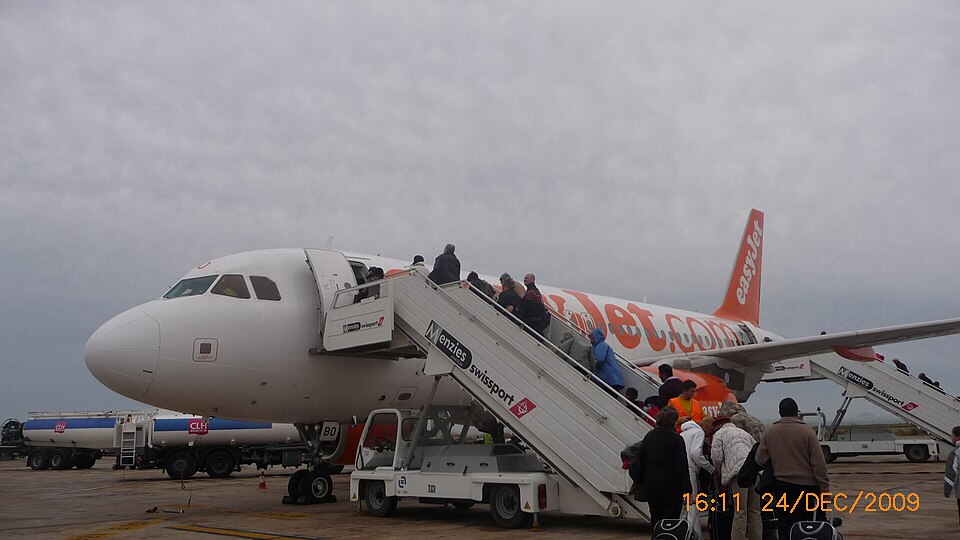
Event Description
On 29 April 2011 at 05:17 UTC, an Airbus A319, registration G-EZBO, operated by EasyJet PLC as flight 983 from Rome Fiumicino to Venice, experienced a serious incident during takeoff. Just before rotation, the crew heard an unusual noise and informed air traffic control. All onboard indications were normal, and the landing gear was retracted as usual. The crew decided to continue to destination.
During cruise, ATC informed the crew that a piece of tire had been found on the runway. The flight proceeded without further issues, including the approach phase. When the landing gear was extended, the ECAM ALTN L brake message activated. The aircraft landed normally. After landing, the left parking brake was found inoperative, and damage to the left wing was observed. The covering of tire no. 4 on the main landing gear was found to be detached. The tire remained inflated after landing.
Aircraft and Tire Information
The Airbus A319 (serial number 3082, built in 2007) was powered by two CFM56 turbofan engines. The damaged tire was a Michelin 46x17.0R20/30/225 (part M01103-02, serial 0174C072), which had been retreaded at Michelin's facility in Burges, France. The retreading process involves acceptance inspection (including shearography), buffing, solution application, new tread application, vulcanization, and final checks.
Investigation Findings
The investigation determined that the tread separation was not caused by foreign object damage, cuts, or incorrect inflation pressure. A technical report from the tire manufacturer, based on seven similar cases, indicated that the separation likely resulted from a channel of non-adhesion between the retread layers formed during the retreading process. This defect was not detectable by visual inspection. The report noted that shearographic examination could identify such defects but was not performed at the end of the retreading process; it was only done at the initial acceptance stage. Following these events, the manufacturer began using shearographic control also at final release.
Damage
The detached tire covering caused rupture of the flange securing the brake system tubes on the main landing gear half-axle. Debris from the covering and flange struck the lower surface of the left wing, deforming the flap and creating a small hole in the paneling. No other damage to persons or property occurred.
Cause
The cause of the event was attributed to a technical factor, specifically a likely production defect in the tire retreading process.