Incident Overview
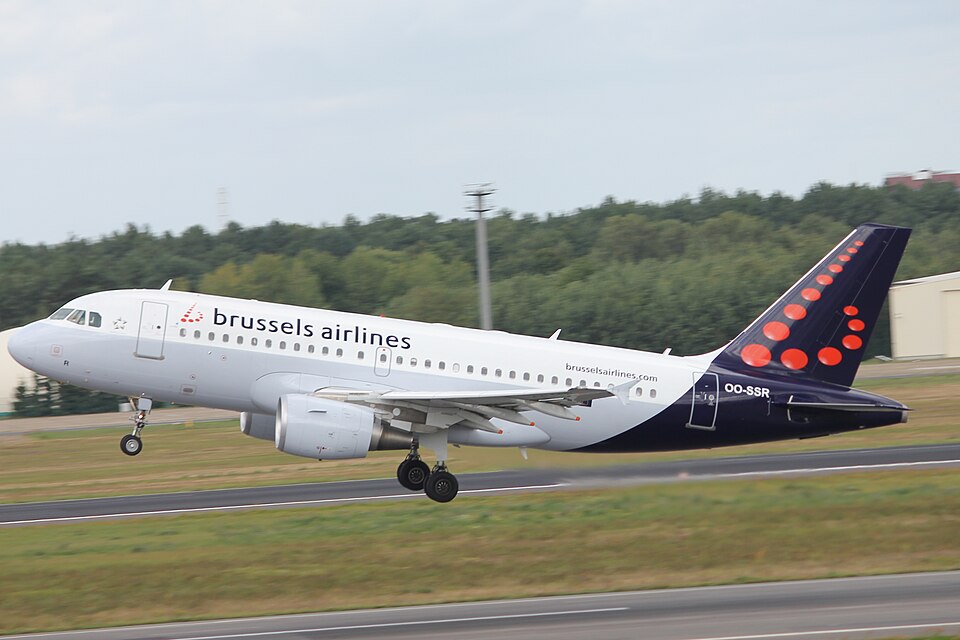
On 8 February 2012 at 08:30 local time, two aircraft on approach to runway 25R at Barcelona Airport experienced a TCAS RA (Traffic Alert and Collision Avoidance System Resolution Advisory) warning. The minimum radar separation between them reached 1.4 NM horizontally and 400 ft vertically. The aircraft involved were Brussels Airlines flight BEL3HH (registration OO-SSR, Airbus A319) and Iberia flight IBE0716 (registration EC-HAG, Airbus A330-214). A third aircraft, Delta Airlines flight DAL114 (Boeing 777), was also converging on the approach.
Sequence of Events
The controller initially established a landing sequence with DAL114 first, IBE0716 second, and BEL3HH third. After observing that DAL114 and BEL3HH were separated by 8 NM with the latter 30 kt faster, the controller determined there was insufficient room to insert IBE0716 behind DAL114 due to required 5 NM separation for heavy wake turbulence. Consequently, the sequence was changed: IBE0716 was rerouted left to land behind BEL3HH. While IBE0716 was turning, the TCAS RA warning occurred.
Aircraft and Crews
BEL3HH had taken off from Brussels with 122 passengers and 5 crew. The captain held an ATPL(A) with 9,460 total flight hours (70 on type); the first officer held a CPL(A) with 3,450 hours (600 on type). IBE0716 had departed from Madrid with 48 passengers and 6 crew. Its captain held an ATPL(A) with 11,568 hours (4,267 on type); the first officer held an ATPL(A) with 7,461 hours (all on type).
Controller and Pilot Reports
The executive controller reported that he changed the sequence after determining insufficient separation due to heavy wake turbulence. He instructed IBE0716 to turn to heading 060° and maintain 4,000 ft, and BEL3HH to descend to 2,300 ft. IBE0716 turned later and wider than expected, reducing separation. The controller then instructed IBE0716 to turn to 050° and BEL3HH to accelerate descent, but both aircraft received TCAS RAs.
The captain of BEL3HH reported that the first officer was flying. A TCAS caution activated with an amber traffic signal at 2 o'clock, slightly above, and climbing. They received an RA to descend at 1,500 ft/min, which the first officer executed. The captain informed ATC. The IBE0716 captain stated they were radar vectored to runway 25R. ATC instructed a left turn to 060° due to the preceding aircraft's delayed turn, then to 050°. They received a TCAS climb warning, executed the maneuver to about 4,700 ft, and then returned to 4,000 ft after the warning cleared. They were in visual contact with the other traffic throughout.
Flight Recorder Data
QAR data from IBE0716 showed that at 08:29:32, ATC instructed the turn to heading 060°. The aircraft was at 3,804 ft and 212.4 kt, heading 180°. The course change began at 08:29:39 and was fully executed in 55 seconds. The TCAS RA was received at 08:30:24 while the aircraft was on course 078°. After the RA, the aircraft continued to 050° as instructed.
Air Traffic Control Systems
The STCA (Short Term Conflict Alert) was inhibited below FL195 in Barcelona TMA to reduce nuisance warnings, so it was not operational during the incident. AENA has no general procedures for STCA use in TMAs but reported working to improve system predictability.