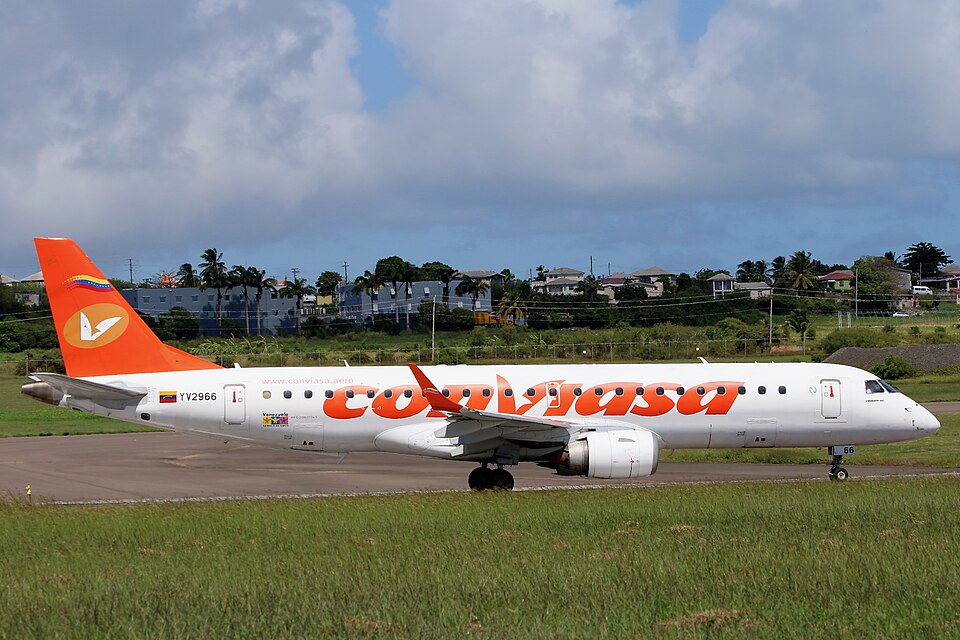
What happened
On August 30, 2021, at 20:48 UTC, an Embraer ERJ 190-100 IGW, registration YV2966, was performing a scheduled commercial flight from General en Jefe Santiago Mariño International Airport (SVMG) in El Yaque to Arturo Michelena International Airport (SVVA) in Valencia. The aircraft was carrying 80 passengers and 7 crew members.
Shortly after takeoff, while climbing through 400 feet and retracting the landing gear, the crew observed a "Bleed 1 Fail" indication on the EICAS. Although the crew performed the abnormal checklist and the indication initially cleared, the fault subsequently returned as a persistent message. Per the Quick Reference Handbook (QRH) limitations, the aircraft was restricted from flying above 31,000 feet.
As the aircraft reached 18,000 feet, a second indication appeared: "Bleed 2 Leak." Following established procedures, which required starting the APU and leveling off at 15,000 feet if both bleed systems failed, the crew requested descent to 13,000 feet from Maiquetía Area Control Center. The flight crew then decided to return to the departure airport. The aircraft landed safely at El Yaque with no injuries to the passengers or crew and no damage to the airframe.
The investigation
The JIAAC investigation involved interviewing the flight crew and reviewing extensive documentation, including pilot licenses, medical certificates, and maintenance logs. Investigators examined the aircraft's airworthiness status and the maintenance records from the operator's maintenance organization (OMAC-N 431).
To validate corrective actions, inspectors verified that the E-Seal and Incopel of the Nacelle Pressure Regulating shutoff valve on engine number two had been replaced in accordance with the Aircraft Maintenance Manual (AMM). Following these repairs, the components were confirmed to be operating satisfactorily.
Findings
- The primary cause of the incident was a failure of the E-Seal and Incopel within the Nacelle Pressure Regulating shutoff valve of the number two engine.