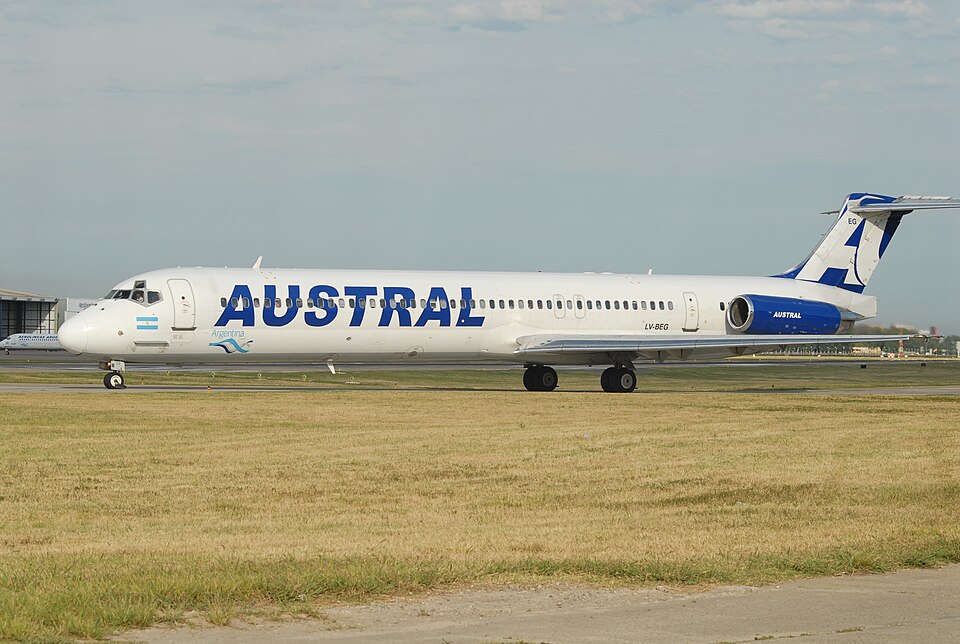
Maintenance Manual Ambiguity Linked to Dual Engine Oil Leaks on Boeing MD-83

Casualties unknown • Aeropuerto Tucumán (Tucuman), AR

An investigation into two separate oil pressure failures on an Andes Líneas Aéreas Boeing MD-83 revealed that imprecise maintenance instructions led to improper torque application.

What happened

On March 7, 2018, a Boeing MD-83, registration LV-BEG, operated by Andes Líneas Aéreas, experienced a significant technical issue during a scheduled commercial flight from Perico to Buenos Aires. While cruising at flight level 330, approximately 120 miles from the Tucumán VOR, the flight crew noticed a discrepancy in the oil level indicators and a drop in oil pressure within the left engine. In response to the developing situation, the crew elected to shut down the left engine and requested a diversion to Tucumán International Airport.

The aircraft landed safely at Tucumán at 12:25 UTC, and all 162 passengers and crew were disembarked without injury. This event followed a remarkably similar incident involving the same aircraft just 39 days earlier, when the right engine experienced a drop in oil pressure during a flight from Brazil to Córdoba.

The investigation

The JIAAC investigation focused on the technical failure of the lubrication system and the maintenance practices applied to the aircraft. Investigators examined the maintenance records and found that the most recent significant maintenance performed on the failed component was a functional check of the differential pressure switches during a 2C inspection three months prior. This task involved disconnecting the pressure lines.

Technical analysis of the maintenance manuals revealed that the instructions for the switch functional check did not explicitly warn the technician of the specific torque requirements for the tube connection. Instead, the necessary torque values were located in a separate, more difficult-to-navigate section of the Aircraft Maintenance Manual (AMM) under standard practices. The investigation also reviewed the training and certification of the maintenance personnel, finding that the technicians involved were properly licensed and trained according to regulatory standards.

Findings

  • The oil loss in both engines occurred due to a crack in the flare of a pressure tube connecting to the differential pressure switch.
  • The crack was caused by excessive torque applied to the union nut during the reconnection of the tube.
  • This over-torque created a fatigue point that allowed a crack to propagate through each engine cycle, eventually leading to the oil leak.
  • The maintenance documentation lacked the necessary precision and clarity, as it failed to highlight the specific torque requirements for this particular task, making it difficult for technicians to locate the correct values within the AMM.

Probable cause

The primary cause of the oil pressure failures was the application of excessive torque to the engine oil pressure tube union, driven by ambiguous maintenance manual instructions that failed to explicitly specify torque requirements for the task.

Frequently asked questions

What happened in the 2018-03-07 MC DONNELL DOUGLAS MD-83 accident near Aeropuerto Tucumán (Tucuman), AR?

An investigation into two separate oil pressure failures on an Andes Líneas Aéreas Boeing MD-83 revealed that imprecise maintenance instructions led to improper torque application.

What aircraft was involved and where did it happen?

The accident on 2018-03-07 involved a MC DONNELL DOUGLAS MD-83, registration LV-BEG, operated by Aviación Comercial, at Aeropuerto Tucumán (Tucuman), AR.

What was the probable cause of the accident?

The primary cause of the oil pressure failures was the application of excessive torque to the engine oil pressure tube union, driven by ambiguous maintenance manual instructions that failed to explicitly specify torque requirements for the task.

Loading the flight search…