History of Flight
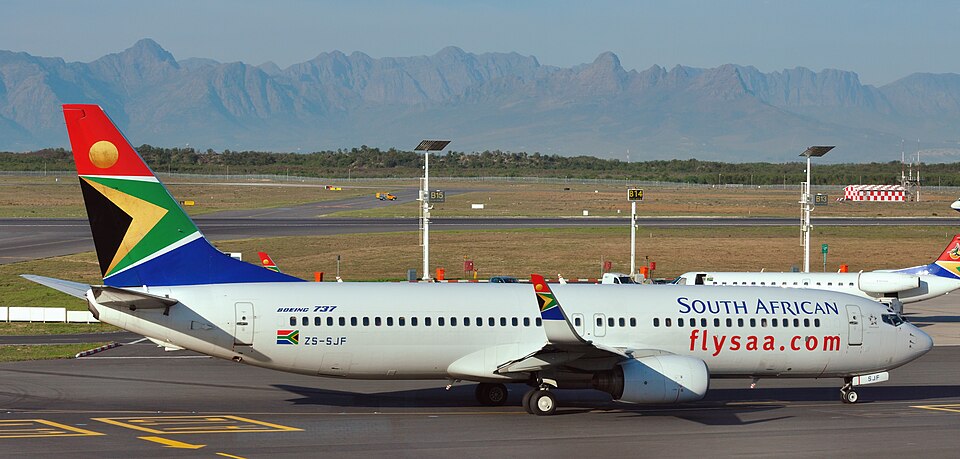
On 25 January 2021, a Boeing 737-800 with registration ZS-SJF, operated by Mango Airlines, departed O.R. Tambo International Airport (FAOR) on a scheduled flight to King Shaka International Airport (FALE). The aircraft carried six crew members (two pilots and four cabin crew) and 119 passengers. The captain served as pilot monitoring (PM), and the first officer was pilot flying (PF). Before takeoff, pressurization and air conditioning system switches were set according to the Quick Reference Handbook (QRH). The aircraft climbed and leveled off at flight level (FL) 350.
During descent to FALE at 1232Z, after passing FL270 abeam Dundee, the "Cabin Altitude" rapid decompression warning light illuminated, accompanied by an audio aural warning. The captain cross-checked the outflow valve position and broadcast a MAYDAY call three times on VHF 125.75 MHz to the area controller. The crew donned oxygen masks and manually deployed passenger oxygen masks. The captain initiated Cabin Alt warning checks per the QRH. The aircraft leveled off at FL090 and conducted a normal approach and landing on Runway 24 at FALE. No injuries were reported, and no damage occurred to the aircraft.
Aircraft Information
The aircraft was a Boeing 737-800, registration ZS-SJF, operated by Mango Airlines. Prior to departure, the aircraft had two deferred snags: an inoperative auxiliary power unit (APU) and an illuminated No.1 engine nose cowl anti-ice amber light. As a result, the No.1 engine 5th stage bleed air valve was locked open, and the 9th stage bleed air valve was locked closed, as per Minimum Equipment List (MEL) 30-03-03B.
Investigation Findings
The investigation determined that the aircraft was unable to maintain cabin pressure for a safe environment due to a bleed air leak from the right-side air-conditioning pack. The left-side pack could not compensate because the No.1 engine's 9th stage bleed air valve was locked closed prior to departure from FAOR. Contributing factors included defective right-side air-conditioning pack components: the primary heat exchanger, air cycle machine, sense line, and trim air check valve.